
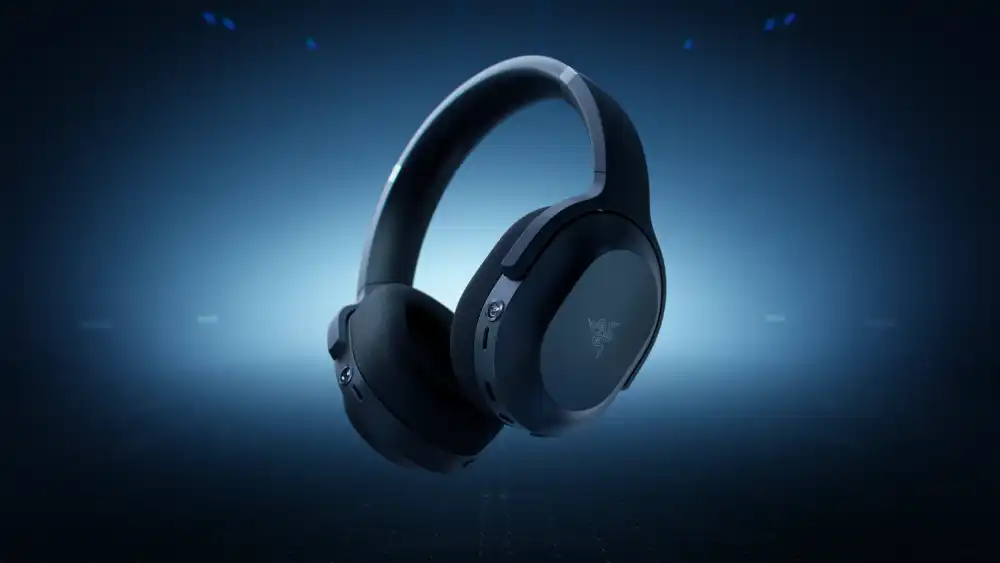
Razer Project Motoko: AI Headset Specs Explorer
Compare features, explore capabilities, and understand the technology behind Razer’s concept AI wearable
The concept addresses practical limitations that have affected smart glasses adoption. Battery capacity stands out as a primary advantage—Project Motoko reports 36 hours of continuous operation with AI services active, exceeding the 4-8 hours typical of current AI-powered wearables. The over-ear form factor accommodates larger batteries and more powerful processors while maintaining audio privacy through enclosed speakers.
Unlike smart glasses that typically integrate with a single AI ecosystem, Project Motoko supports multiple platforms including OpenAI, Google Gemini, and xAI’s Grok. This platform-agnostic approach allows users to switch between AI services based on task requirements without hardware constraints. The headset uses voice commands for interaction, with dual far-field and near-field microphones capturing both user input and environmental audio.
📊 Interactive Specifications Comparison
The dual 12-megapixel cameras capture 3K resolution spatial video at 60 frames per second, positioned at eye level to match the user’s natural viewpoint. This configuration enables real-time object recognition, text translation, and document scanning. The official Razer announcement describes the system as providing “stereoscopic precision with sub-millimeter accuracy and a wide field of attention beyond human peripheral vision.”
Project Motoko’s AI capabilities extend beyond personal assistance to data collection for machine learning applications. The cameras capture authentic human point-of-view vision data including depth, focus, and attention patterns, which Razer suggests could train humanoid robots and autonomous systems. This dual-purpose design positions the device for both consumer and research markets, though specific developer programs have not been detailed in current announcements.
The partnership between Razer and Qualcomm Technologies underpins the technical implementation. Ziad Asghar, SVP and GM of XR at Qualcomm, stated in the press release: “As we transition to an era of multiple AI powered Personal devices such as Project Motoko, that can see and hear and work together with an AI agent to anticipate your every need.” The collaboration leverages Qualcomm’s XR and AI processing capabilities, though the specific Snapdragon chip model remains unconfirmed.
🎯 Explore Key Features
Augmented AI Computer Vision
Project Motoko employs dual first-person-view cameras positioned at natural eye level to capture the user’s perspective. The system performs real-time object and text recognition, enabling applications like translating street signs, tracking workout repetitions, or summarizing documents without manual input.
Dual Far and Near-Field Microphones
The multi-microphone array captures voice commands, nearby dialogue, and environmental sounds. This configuration allows the system to distinguish between direct user input and ambient audio, supporting accurate voice recognition in varied acoustic environments.
Universal AI Platform Compatibility
Project Motoko connects with multiple AI platforms including OpenAI’s ChatGPT, Google’s Gemini, Meta AI, and xAI’s Grok. Users can switch between services based on task requirements or personal preference, avoiding vendor lock-in that characterizes many current smart glasses products.
Practical Applications
Demonstrated use cases include translating foreign language text, identifying objects in the user’s field of view, providing contextual gaming advice based on visual data, generating recipe ideas from visible ingredients, and offering real-time navigation information through voice commands.
⚡ Battery Life Comparison
Extended battery capacity represents a primary advantage of the headphone form factor over compact smart glasses designs.
The concept device remains in development with no confirmed release date or pricing. Nick Bourne, Global Head of Mobile Console Division at Razer, described Project Motoko in the official announcement as “more than a concept, it’s a vision for the future of AI and wearable computing.” Representatives at CES 2026 indicated intent to commercialize the product at a price competitive with smart glasses, which currently start at $379 for Meta’s Ray-Ban collaboration.
Market positioning differentiates Project Motoko from the growing smart glasses category. Rather than competing directly with AR eyewear, the headphone approach targets users who already wear over-ear headphones during commutes, work sessions, or gaming. This includes scenarios where smart glasses face adoption barriers—users who wear prescription eyewear, prefer not to wear glasses for social reasons, or require extended battery life for all-day use.
The technology ecosystem extends beyond the headset itself. Razer has announced related AI initiatives including Project AVA, an animated AI desk companion, and developer tools like the Razer AIKit for low-latency AI workflows. These products share the universal AI platform compatibility approach, positioning Razer as a provider of AI infrastructure rather than competing AI services. For context on broader AI wearable developments, see coverage of alternative form factors at CES 2026.
Stay Informed on AI Wearable Technology
Project Motoko represents one approach to AI wearable computing among multiple form factors under development across the technology industry.
Project Motoko was unveiled at CES 2026 as a concept device exploring headphones as a platform for AI wearable computing. The specifications include dual 12-megapixel cameras capturing 3K/60fps spatial video, 36-hour battery life with AI services active, universal compatibility with multiple AI platforms, and integration with Qualcomm Snapdragon processors. The device remains in concept stage without confirmed pricing or release timeline.
The announcement included technical details on computer vision capabilities, multi-microphone audio sensing, and applications ranging from personal assistance to robotics training data collection. Razer’s partnership with Qualcomm Technologies provides the processing foundation, though specific chip models have not been disclosed. Additional information about specifications and potential availability can be found through Razer’s official newsroom and related coverage of AI hardware developments at CES 2026.