
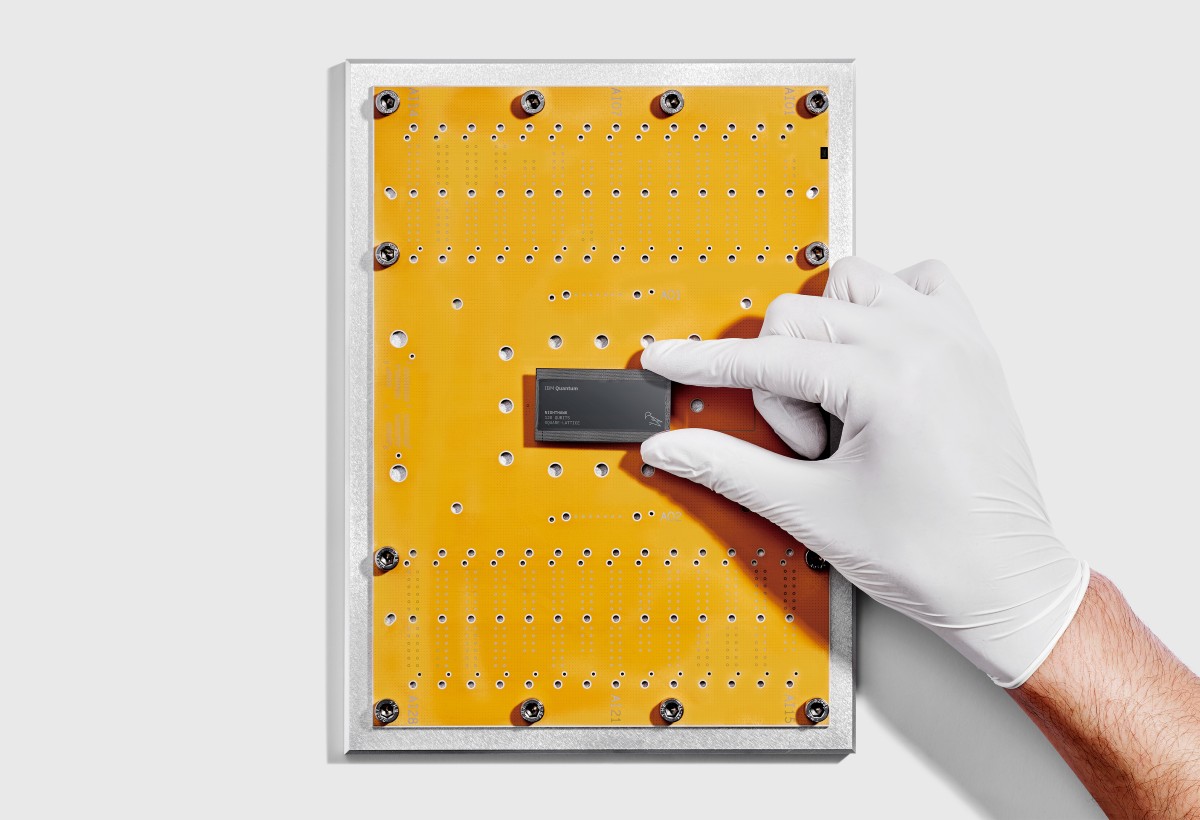
IBM announced two quantum processors at its annual Quantum Developer Conference on November 12, 2025, targeting quantum advantage by the end of 2026 and fault-tolerant quantum computing by 2029. The announcements come as major technology companies accelerate infrastructure investments, with Anthropic expanding AI infrastructure and OpenAI advancing GPT-5 capabilities.
The company introduced IBM Quantum Nighthawk, a 120-qubit processor designed for near-term applications, alongside the experimental IBM Quantum Loon processor, which demonstrates all hardware components needed for fault-tolerant systems. IBM shifted primary fabrication to a 300mm wafer facility at NY Creates’ Albany NanoTech Complex, doubling development speed and increasing chip complexity tenfold.
IBM’s Quantum Computing Advance
Two processors chart the path to quantum advantage by 2026 and fault-tolerant computing by 2029
The Two Quantum Processors
IBM announced two processors, each targeting different quantum computing milestones with distinct architectural approaches
- 120 qubits linked with 218 next-generation tunable couplers in a square lattice configuration
- Executes circuits with 30% more complexity than IBM Quantum Heron while maintaining low error rates
- Supports problems requiring up to 5,000 two-qubit gates, the fundamental entangling operations
- Expected delivery to users by end of 2025
- Target: Verified quantum advantage by end of 2026
- First processor demonstrating all key components needed for fault-tolerant quantum computing
- Six-way qubit connectivity with connections that can “break the plane” vertically
- Multiple high-quality, low-loss routing layers for longer on-chip connections
- Technologies to reset qubits between computations
- Target: Large-scale fault-tolerant quantum computer by 2029
Jay Gambetta, Director of IBM Research and IBM Fellow, stated at the conference: “There are many pillars to bringing truly useful quantum computing to the world. We believe that IBM is the only company that is positioned to rapidly invent and scale quantum software, hardware, fabrication, and error correction to unlock transformative applications.”
The Nighthawk processor features 218 next-generation tunable couplers, representing over 20% more couplers compared to IBM Quantum Heron. This increased qubit connectivity allows circuits with 30% more complexity while maintaining low error rates. Each qubit connects to its four nearest neighbors in a square lattice, supporting up to 5,000 two-qubit gates.
IBM’s Quantum Development Timeline
Development milestones from 2025 through 2029 based on IBM’s roadmap
Key Technical Achievements
Major technical milestones announced alongside the new processors
Manufacturing and Development Impact
IBM’s shift to 300mm wafer fabrication brings significant improvements
Quantum Advantage Tracker Partners
IBM is collaborating with leading organizations to verify emerging quantum advantage demonstrations
The community tracker supports three experiments for quantum advantage across observable estimation, variational problems, and problems with efficient classical verification. IBM anticipates the first cases of verified quantum advantage will be confirmed by the wider community by the end of 2026.
For detailed technical specifications and official announcements, visit IBM’s newsroom.
The announcement covered IBM’s quantum processor developments, including the Nighthawk and Loon chips, along with software improvements to Qiskit and manufacturing advances at the Albany NanoTech Complex. The company outlined a timeline targeting quantum advantage by 2026 and fault-tolerant quantum computing by 2029.
IBM also discussed the quantum advantage tracker, a community-led initiative with partners including Algorithmiq, Flatiron Institute, and BlueQubit. The announcement included details on error correction techniques, including real-time decoding using qLDPC codes achieved in under 480 nanoseconds.