Gun Policy Update · United States · June 2026
3D Guns & Ghost Gun Laws

When Your 3D Printer Gets a Conscience

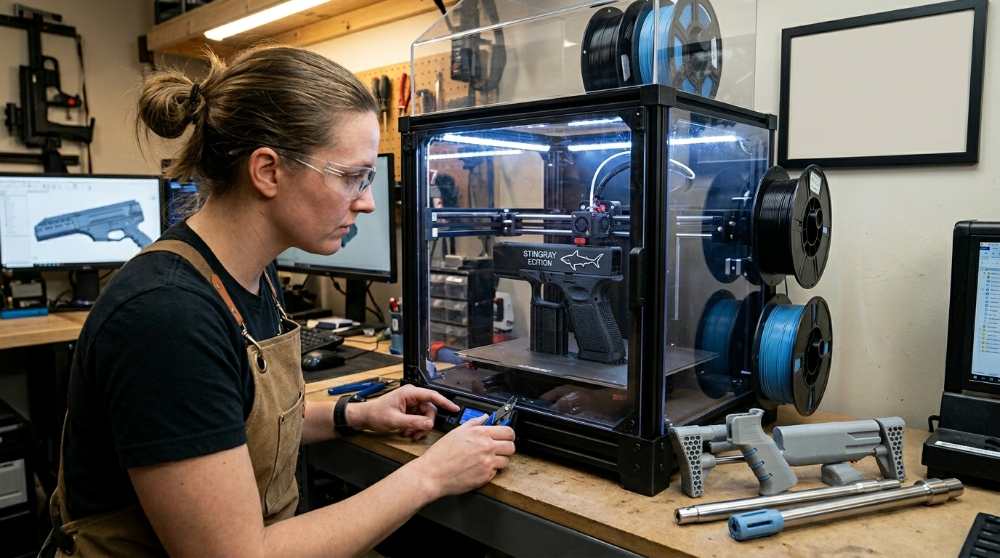
New York became the first U.S. state to require 3D printers to carry built-in technology that blocks the printing of firearms. Governor Kathy Hochul signed the law on May 27, 2026 as part of the state’s FY2027 budget. California is considering similar legislation. At least 16 states now have some form of 3D gun restriction on the books — and the legal battles are just beginning. The story connects to broader conversations about technology, regulation, and accountability that are reshaping policy across sectors.

The rise of untraceable “ghost guns” — firearms without serial numbers — has been tracked by the ATF. Between 2017 and 2023, law enforcement recovered 92,702 suspected privately-made firearms, with annual recoveries growing from 1,629 in 2017 to 27,490 in 2023. The December 2024 killing of UnitedHealthcare CEO Brian Thompson brought renewed attention to the issue: authorities said the suspect allegedly carried a gun that may have been 3D-printed. Coverage of that case echoes wider questions about corporate and civic accountability that remain unresolved.

92,702
Ghost guns recovered by law enforcement, 2017–2023
1,600%
Surge in ghost gun crime recoveries, 2017 to 2023
16+
U.S. states with 3D gun laws on the books as of 2026
2029
Earliest NY enforcement date for the printer-blocking mandate
States with 3D Gun Laws — Click a State for Details
AK HI WA CA CO MN VA ME NY ★ NJ 1st in nation N↑ Click any colour-coded state for details · 16+ states have 3D gun laws as of 2026
Enacted Law
Advancing / Pending
Serial Number Requirement
Failed / Stalled
No Legislation (yet)
Filter by Status

How the Blocking Technology Would Work

01
File Submitted
A user sends a 3D design file (.STL or .CAD) to the printer’s software before printing begins.
02
Algorithm Scans
A firearm blueprint detection algorithm analyzes the file’s geometry — shape, dimensions, structural features — and compares it to a library of known firearm parts.
03
Match = Block
If the design closely resembles a firearm component, the printer refuses to execute the job. The concept is similar to how a photo app identifies plants or flowers from an image.
04
Standards Set Later
NY’s Division of Criminal Justice Services will lead an expert working group to define the exact technical standards before enforcement begins — currently no earlier than 2029.
Supporters vs. Critics: What’s the Argument?
✓ In Favour
Creates a technical barrier for those legally barred from buying guns — children, convicted felons — who might otherwise use a 3D printer to manufacture one.
Ghost gun crime recoveries rose 1,600% in six years. Advocates say the law addresses an accelerating trend that existing serial number regulations haven’t stopped.
AI-driven geometric analysis is described as a mature technology already used in industrial design software and ready for deployment.
Everytown for Gun Safety notes that more affordable printers are putting firearm manufacturing within reach of teenagers and school-age children.
✗ Against
The Association of 3D Printing supports the law’s intent but says the technology “is not going to work” — criminals can alter designs or take projects to unregulated machines.
The Electronic Frontier Foundation warns aggressive filtering algorithms capture unintended objects — ordinary pipes or common hardware can resemble gun parts geometrically.
If files must be submitted to a cloud-based AI for scanning, the privacy of artistic and proprietary designs may be at risk, according to EFF’s Rory Mir.
The NRA argues the measures restrict law-abiding Americans from constitutionally protected activities while doing little to stop determined bad actors.
We’re going to put technology into our machines such that they will not be a 3D gun. Much like, you know, we don’t have commercial printers that print U.S. currency.
— Manhattan DA Alvin Bragg, comparing the law to existing counterfeit-currency protections in printers
These measures only restrict responsible Americans — who do follow the law — from participating in constitutionally protected activities.
— John Commerford, Executive Director, NRA Institute for Legislative Action
These sort of censorship algorithms don’t work, and they wind up capturing and blocking a lot of lawful speech.
— Rory Mir, Director of Open Access & Technology, Electronic Frontier Foundation
3D printing really is the new frontier of the fight against ghost guns.
— Samuel Levy, Director of Policy Advocacy, Everytown for Gun Safety
A Timeline of 3D Gun Policy in the U.S.
2012–2013
An estimated 30,000 3D printers exist worldwide. Defense Distributed produces the first fully 3D-printed firearm — the “Liberator” — triggering federal scrutiny of digital gun blueprints.
2017
ATF records 1,629 ghost gun recoveries — the baseline for what follows. The privately-made firearm problem at this point is modest but growing.
December 2024
UnitedHealthcare CEO Brian Thompson is fatally shot in New York City. Authorities say the suspect Luigi Mangione allegedly carried a gun that may have been 3D-printed, reigniting national debate over ghost gun access.
January 2026
Maine requires serial numbers on all firearms including 3D-made guns. New Jersey Gov. Phil Murphy signs Bill A4975, requiring a firearms licence to even possess 3D gun blueprints. Governor Hochul announces first-of-its-kind 3D printer blocking proposals in NY. The physical-digital crossover in technology enters a new regulatory era.
February 2026
A three-judge panel on the U.S. Court of Appeals for the Third Circuit sides with New Jersey against Defense Distributed, upholding a cease-and-desist ordering the company to stop distributing gun-printing blueprints to unlicensed individuals. Defense Distributed says it will petition the Supreme Court if further appeals fail.
March 2026
Washington Governor Bob Ferguson signs a law restricting possession of serialless weapons and constraining digital blueprint distribution. Colorado and Virginia pass separate laws against unserialized weapons. A Minnesota legislative package fails to advance in the statehouse.
May 27, 2026
Governor Hochul signs the NY FY2027 budget (S.9005-C / A.10005-C) into law. The printer-blocking mandate becomes the first of its kind in the nation — though enforcement awaits an expert working group’s standards and is not expected before 2029. See the NBC LA coverage for reaction.
Mid-2026
California advances a bill that would similarly require 3D printer manufacturers to include firearm-blocking technology. At least 16 states now have 3D gun laws on the books, with seven adding major legislation in 2026 alone. Broader technology regulation debates echo the same tensions between access, safety, and privacy.

New York’s 3D printer gun-blocking law has been covered here as the first legislation of its kind in the United States. The law was signed on May 27, 2026, mandates firearms-blueprint detection technology in 3D printers sold in the state, and sets up an expert working group to define enforceable standards — with no mandate taking effect before 2029. The debate around the law has been framed by arguments about technical feasibility, Second Amendment rights, and digital privacy. Legal challenges to similar laws elsewhere in the country are ongoing, including Defense Distributed’s petition seeking further review after the Third Circuit ruling against it. The broader wave of state-level action — across New York, California, New Jersey, Colorado, Virginia, Washington, and Maine — has been reported here alongside the growing regulation of AI-adjacent tools in the public interest.