
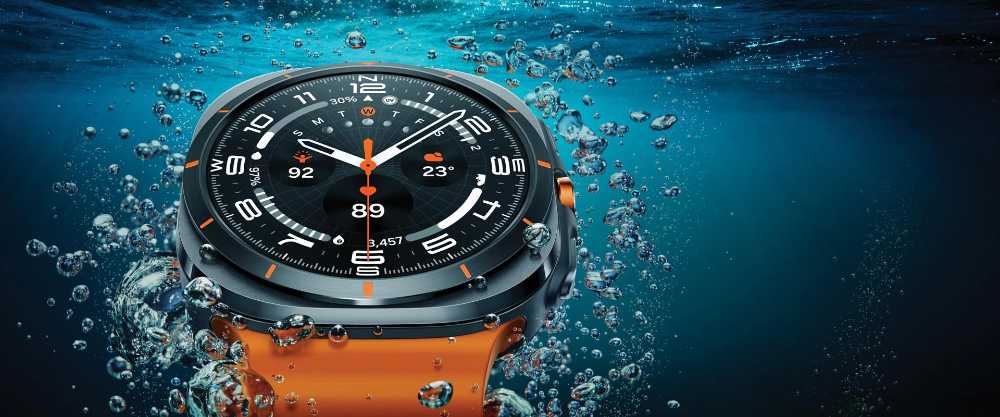
Three watches went to customs. Only two came back with paperwork.
Tap each model below to see exactly what the FCC and CMIIT filings confirm — and what’s still sitting in leak territory.
SM-L350 · SM-L355
(cellular model)
in either database
Filed under the FCC database in the United States and the CMIIT database in China, with filings reported on June 15, 2026. The 40mm size carries model numbers SM-L340 and SM-L345, while the 44mm size is listed as SM-L350 and SM-L355.
A separate 3C charging filing confirmed the Watch 9 sticks with 10W wired charging at 5V/2A — the same speed as the Galaxy Watch 8 series.
The cellular version of the Watch Ultra 2 cleared certification as SM-L715. Reports point to a roughly 784mAh battery, up from 590mAh in the original Galaxy Watch Ultra — about a 35% capacity jump, though Samsung has not confirmed this figure itself.
The Ultra 2 is also tipped to be Samsung’s first smartwatch with 5G RedCap connectivity, a low-power, narrowband 5G standard built for wearables rather than phones.
Devices typically only reach FCC and CMIIT databases once hardware is finalized for production. With no Classic model number in either filing as of mid-June 2026, the practical window for one to ship alongside the Watch 9 and Ultra 2 in July has all but closed.
The Watch Classic line has shipped every year since the Galaxy Watch 4, including the Galaxy Watch 8 Classic in July 2025. Samsung has not officially confirmed a discontinuation — but no certification paper trail exists for one this cycle.
Samsung’s next round of major hardware announcements is closing in fast, and this time the paper trail is doing the talking before Samsung does. Regulatory filings reported June 15, 2026 confirm the Galaxy Watch 9 and Galaxy Watch Ultra 2 have cleared both FCC certification in the United States and CMIIT approval in China — but the Galaxy Watch 9 Classic, the model with the signature rotating bezel, has not shown up in either database.
That absence matters because of how these databases work. The FCC tests devices for radio frequency emissions before they can be sold in the US; CMIIT does the same job for China. Manufacturers typically only file once hardware is locked for mass production — so a missing model number this close to launch is one of the clearest public signals available before a company speaks officially. Leaked renders shared on social media back this up, pointing to new black, silver, and beige color options for the lineup with no Classic variant among them.
Every Galaxy Watch since 2018 has run on Samsung’s own Exynos chip. That streak may be ending — but only for one of the two new models.
The chip question carries real weight for buyers. Qualcomm’s Snapdragon Wear Elite, announced at MWC 2026 in Barcelona, is built on a 3nm process with a big.LITTLE design — one performance core at 2.1GHz paired with four efficiency cores at 1.95GHz — which Qualcomm says delivers five times the single-core performance of its previous wearable chip. Its standout feature is a dedicated Hexagon neural processing unit that can run AI models with up to 2 billion parameters directly on the watch, at roughly 10 tokens per second, without needing a phone or cloud connection.
If the Ultra 2 gets that chip while the standard Watch 9 keeps an Exynos processor, as a Notebookcheck report attributed to tipster Jason C suggests, it would be the first time Samsung has split silicon between its two smartwatch tiers rather than just changing design and battery size. Other outlets, including Sammy Fans, have reported both models could share the Snapdragon chip — Samsung has not clarified which scenario is accurate.
None of this happens in a vacuum. Samsung itself has already confirmed where its software is heading: a Samsung Health update beginning June 8, 2026 reorganizes the app around five pillars — Sleep, Activity, Nutrition, Mindfulness, and Vitals — feeding into a single AI-generated Energy Score. A new Vitals feature checks five overnight signals (heart rate, heart rate variability, breathing rate, skin temperature, and blood oxygen) against a person’s own baseline and only sends an alert when something meaningfully shifts. A Daily Cardio Load feature factors in accumulated training strain to adjust workout recommendations and rest periods on the fly.
Samsung Health is evolving to connect health data measured by Galaxy Watch with AI-based insights, enabling users to understand their physical and mental condition more easily and intuitively. Samsung Electronics will continue to expand proactive and personalized health management experiences based on the connected Galaxy ecosystem and digital health innovations.
None of the software or hardware details above come from an Unpacked stage yet. Samsung has not confirmed a July 22 event date in London, hasn’t named a price, and hasn’t said which chip goes into the standard Watch 9. The battery figure, the 5G RedCap claim for the Ultra 2, and the Classic’s disappearance all rest on regulatory filings and leaks rather than an official spec sheet. For more on Samsung’s other 2026 service updates, see our coverage of recent streaming and platform outages affecting major tech services this year.
This piece covered what FCC and CMIIT filings show for the Galaxy Watch 9 and Galaxy Watch Ultra 2, the missing Watch 9 Classic filing, the reported Snapdragon Wear Elite chip split, and Samsung’s confirmed Samsung Health software update. Coverage of related wearable hardware, including Snap’s AR glasses pricing and pre-order details and the broader memory chip shortage affecting device pricing industry-wide, continues as new filings and statements come in.