
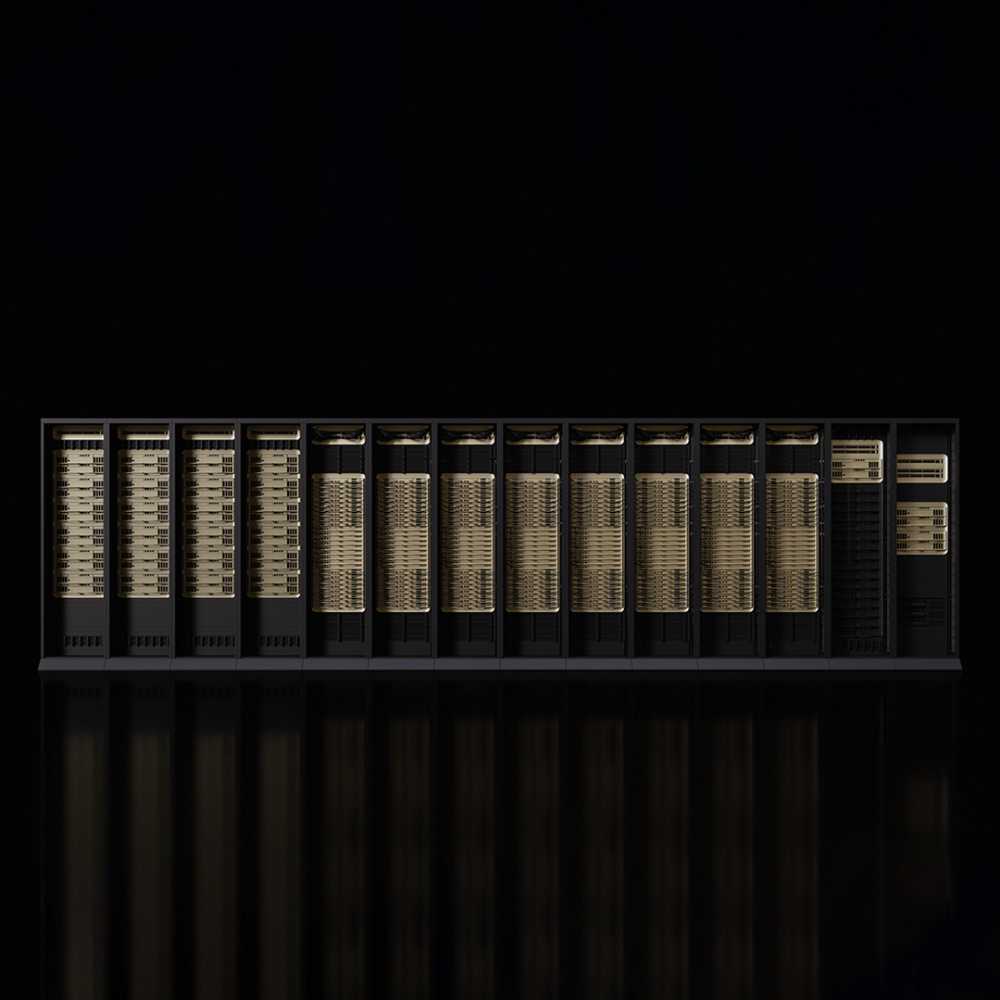
Nvidia announced its next-generation AI system called Vera Rubin at the Consumer Electronics Show in January 2026. The system consists of 1.3 million components and delivers 10 times more performance per watt compared to its predecessor, Grace Blackwell. This efficiency gain addresses energy consumption challenges in AI infrastructure deployment.
The chips are primarily manufactured by Taiwan Semiconductor Manufacturing Company, with more than 80 suppliers across at least 20 countries contributing components. Major customers including Meta, OpenAI, and Anthropic plan to deploy Vera Rubin systems starting in the second half of 2026. Nvidia’s AI infrastructure head Dion Harris stated the company provides suppliers with detailed forecasts to meet production demands.
Nvidia Vera Rubin AI System
Next-generation rack-scale computing with 1.3 million components
Technical Specifications
Vera Rubin represents Nvidia’s most advanced rack-scale AI system. Each rack contains 72 Rubin graphics processing units and 36 Vera central processing units, totaling about 1,300 microchips compared to Grace Blackwell’s 864 chips.
The Vera Rubin superchip contains two Rubin GPUs and one Vera CPU, with 17,000 components in total. The system consumes about twice as much power as Grace Blackwell, but the 10 times performance per watt improvement makes it significantly more efficient for AI workloads. According to Mizuho Securities analyst Jordan Klein, the key metric is tokens per power consumed, which directly impacts return on investment.
System Architecture
Vera Rubin integrates components from a global supply chain spanning more than 80 suppliers in at least 20 countries including China, Vietnam, Thailand, Mexico, Israel, and the United States.
Performance Comparison
Vera Rubin contains about 1,300 total microchips compared to Grace Blackwell’s 864. The performance per watt improvement represents a 10-fold increase, addressing energy efficiency concerns in AI infrastructure.
Development Timeline
Vera Rubin development follows Grace Blackwell’s 2024 production launch. CEO Jensen Huang announced the system entered full production in January 2026 at the Consumer Electronics Show in Las Vegas.
Expected Customer Deployments
Nvidia’s list of expected Vera Rubin customers includes major technology companies and AI research organizations planning deployments in the second half of 2026 and into 2027.
Key Technical Improvements
Vera Rubin introduces several technical improvements over Grace Blackwell, including enhanced energy efficiency, simplified maintenance procedures, and water conservation through liquid cooling.
The system is scheduled to ship in the second half of 2026. Futurum Group estimates pricing at approximately 25% higher than Grace Blackwell, placing Vera Rubin systems around $3.5 million to $4 million per rack. Nvidia faces competition from AMD, which plans to ship its first rack-scale system called Helios later in 2026 with a major commitment from Meta for up to 6 gigawatts of capacity.
Daniel Newman from Futurum Group stated these systems integrate compute, networking, cabling, and cooling into single racks built for efficiency and performance, differing from traditional server construction. Harris acknowledged competition, stating the development represents a complex endeavor. The system addresses memory costs through detailed supplier forecasts as global AI demand creates component shortages. Related developments include tariff impacts on chip manufacturing, AI model developments, and processor ecosystem initiatives.