Enterprise AI · May 2026
Tokens Over Talent:
Salesforce’s $300M Anthropic Bet
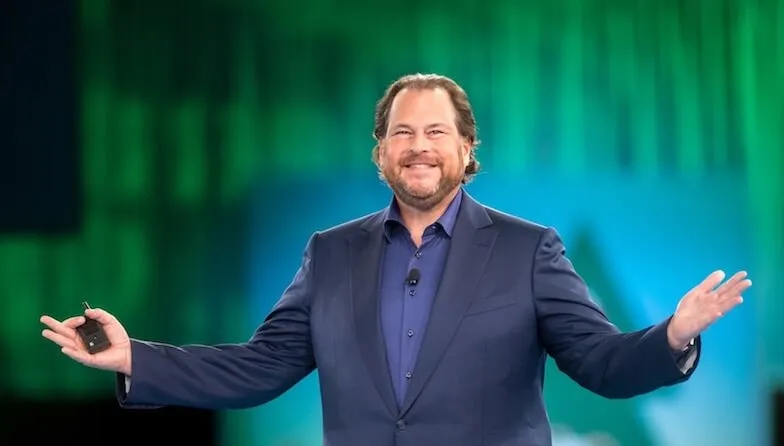
Salesforce CEO Marc Benioff said on the All-In podcast that his company is on track to spend $300 million on Anthropic tokens in 2026 — almost entirely on AI-assisted coding. At the same time, Salesforce has held a freeze on software engineer hiring since 2025, citing productivity gains of over 30% from AI tools. The two facts tell a single, clean story: AI infrastructure spending is replacing headcount budget.
When Hiring Freezes and Token Bills Tell the Same Story: Inside Salesforce’s AI-First Spending Shift
How tokens work
From prompt to product — what Salesforce is actually buying
Every time an engineer at Salesforce asks an AI model to write, review, or refactor code, that interaction consumes tokens — the discrete text units a large language model reads and produces. AI companies bill enterprise customers by the volume consumed. At Salesforce’s scale, that adds up fast.
The announcement
What Benioff said on the All-In podcast
Speaking on the All-In podcast published on May 15, 2026, Benioff said AI coding agents had transformed how his engineering teams work — and how fast software gets to market.
“These coding agents are awesome. Anthropic is awesome. I am going to probably use $300 million of Anthropic this year at Salesforce. Coding. Everything’s going to be cheaper to make.”
— Marc Benioff, CEO, Salesforce · All-In Podcast, May 15, 2026Benioff said efficiency gains across service, support, distribution, and marketing had reached levels he described as “unprecedented.” On the engineering side specifically, he said product iteration had accelerated to the point where he can ship and sell software in parallel — something he described as previously impossible.
He also pointed to new functionality coming for workplace platforms powered by AI. “We’re even working on technology inside Slack to make it easier for everybody to code,” he said, adding: “You’re going to see some cool stuff with Slack and code I’m not ready to talk about yet. But there’s no question that we are in a new moment in coding.”
Benioff’s routing idea — interactive
Not every task needs a frontier model. Try it.
Benioff called for an “intermediary layer” that routes complex AI tasks to frontier models like Claude and simpler ones to cheaper, smaller models. Tap a task below to see how the routing logic works.
Workforce shift
No new engineers hired in 2025 — AI absorbed the demand
In late 2024, Benioff announced Salesforce would not add software engineers in 2025 — the first hiring freeze of its kind for the company’s engineering organisation. He attributed it to productivity gains exceeding 30% from AI tools deployed across engineering teams, including Agentforce and Anthropic models.
Benioff was quick to clarify that the freeze does not mean engineers have been replaced. Salesforce’s approximately 15,000 engineers continue to work alongside AI coding tools — including Anthropic models, OpenAI Codex, and Cursor — increasingly in a supervisory capacity over AI-generated code workflows.
“The model still cannot operate autonomously. When they start to use these models, they’re now working not only with the AI, but agents to help them code — and they can even become somewhat supervisory over these agents. But still, those engineers are needed.”
— Marc Benioff, CEO, SalesforceThe support side of Salesforce’s business has already seen sharper reductions. Last August, Benioff reported the company’s support organisation had dropped from 9,000 to 5,000 staff — a reduction attributed to AI agent productivity. Benioff has described the broader transformation as a “digital labour revolution,” with AI handling between 30% and 50% of Salesforce’s overall workload.
Timeline
How Salesforce’s AI-first shift unfolded
May 2023
Salesforce Ventures joins Anthropic’s Series C ($450M round led by Spark Capital). This is the first of several investment rounds Salesforce participates in.
Late 2024
Benioff announces no new software engineering hires in 2025, citing over 30% productivity gains from Agentforce and AI tools. Salesforce plans to add 1,000–2,000 salespeople instead to sell AI products.
August 2025
Benioff reports support staff cut from 9,000 to 5,000 — 4,000 roles replaced by AI agents. He says AI now handles 30–50% of Salesforce’s overall workload.
March 2026
Salesforce overhauled Slack with 30+ new AI capabilities powered by Anthropic’s Claude — including meeting transcription, desktop monitoring, MCP-based task execution, and lightweight CRM features.
May 15, 2026
On the All-In podcast, Benioff projects $300 million in Anthropic token spend for 2026 — primarily for coding. Salesforce’s total equity investment in Anthropic has also exceeded $300 million, giving it roughly a 1% stake.
Product context
Slack, Agentforce, and the Claude connection
Salesforce’s $27.7 billion acquisition of Slack, completed in July 2021, has become a key layer in its AI strategy. In March 2026, Salesforce overhauled Slackbot with more than 30 new AI capabilities — all powered by Anthropic’s Claude. The updated Slackbot can transcribe meetings, monitor desktop activity, execute tasks through third-party tools via the Model Context Protocol, and function as a lightweight CRM. Benioff has called Slack “the interface to AI,” and noted that AI companies including OpenAI and Anthropic run their own operations on the platform.
Separately, Agentforce — Salesforce’s AI agent product line — reached $800 million in annual recurring revenue as of the most recent earnings, up 169% year-on-year with 29,000 deals closed. From this summer, every new Salesforce customer will have Slack automatically provisioned and AI-enabled from day one. Slack’s revenue is expected to reach $3 billion in 2026. For more on how AI is reshaping platform products, related coverage examines similar shifts across consumer tech.
Investment position
Salesforce is both Anthropic’s customer and its investor
Beyond the token spend, Salesforce holds an equity stake in Anthropic that is separate from its usage costs. Salesforce Ventures first invested in Anthropic’s Series C in early 2023 and has participated in every subsequent round — including the Series G in February 2026. Total capital committed has exceeded $300 million, giving Salesforce roughly a 1% stake in a company now valued at approximately $380 billion. Benioff has stated that Microsoft blocked Salesforce from investing in OpenAI, which directed the company toward Anthropic instead.
Anthropic’s annualised revenue run rate grew from roughly $9 billion at the end of 2025 to approximately $30 billion by March 2026, driven largely by enterprise adoption of Claude for coding, legal, financial services, and general-purpose reasoning. As one of Anthropic’s largest commercial accounts — neither company has confirmed the $300 million figure in official disclosures — Salesforce occupies an unusual position: every token it spends both drives Anthropic’s revenue and increases the value of Salesforce’s equity stake. For context on the broader AI model landscape, Giganectar’s coverage of Gemini tracks competing frontier model developments.
Coverage summary
What was covered
This piece covered Salesforce CEO Marc Benioff’s projection — made on the All-In podcast published May 15, 2026 — that the company would spend $300 million on Anthropic tokens in 2026, primarily for AI-assisted coding. It covered Salesforce’s engineering hiring freeze since 2025, the 30%+ productivity gains attributed to AI tools, the reduction of the support workforce from 9,000 to 5,000, and Agentforce’s $800 million annual recurring revenue figure. The piece also covered Salesforce’s dual role as Anthropic’s investor — with over $300 million committed since the 2023 Series C — and as one of its largest enterprise customers, as well as Benioff’s call for an intermediary routing layer to direct token traffic between frontier and smaller AI models. The Slack overhaul and forthcoming code-related features were also addressed.
Related coverage on competing AI model deployments is available in Giganectar’s Gemini compatibility report. Platform-level AI developments across the wider tech landscape are covered in Giganectar’s platform section.