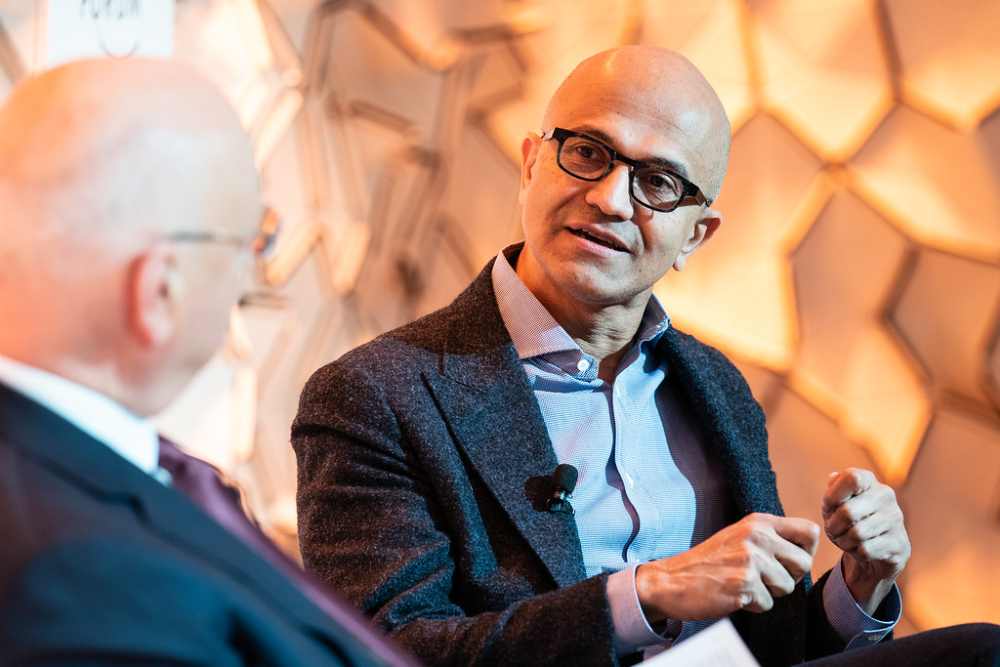
Microsoft CEO Satya Nadella addressed fears of an AI bubble during the World Economic Forum in Davos this January. Speaking with BlackRock CEO Larry Fink, Nadella outlined conditions that would determine whether massive AI investments become sustainable economic drivers or speculative excess.
Tech giants allocated over $360 billion toward AI infrastructure in 2025, with Microsoft alone committing $80 billion to data centers and computing resources. The question now centers on whether these investments will translate into productivity gains across industries beyond technology, or remain concentrated within tech companies themselves.
The AI Bubble Warning: Nadella’s Stark Message from Davos
AI benefits must spread beyond tech giants to avoid becoming a speculative bubble, Microsoft CEO warns
“A telltale sign of if it’s a bubble would be if all we’re talking about are the tech firms. If all we’re talking about is the technology side.”
— Satya Nadella, CEO Microsoft, World Economic Forum 2026
$80B
Microsoft’s AI infrastructure spending in fiscal 2025
$360B+
Combined AI capital expenditure by Meta, Alphabet, Microsoft & Amazon in 2025
1.1%
AI contribution to US GDP growth in first half of 2025
>50%
Microsoft’s AI spending allocated to US-based infrastructure projects
From Investment to Impact: Nadella’s Vision
1
AI Infrastructure Investment — Tech companies invest billions in data centers, chips, and computing power to build foundational infrastructure
2
Token Production — AI systems generate processing tokens as a new economic commodity, similar to electricity generation
3
Widespread Adoption — Industries beyond tech integrate AI into operations including healthcare, manufacturing, agriculture, and education
4
Productivity Gains — Organizations achieve faster drug discovery, better health outcomes, improved learning, and public sector efficiency
5
Economic Growth — Real GDP growth driven by AI-enabled revenue generation across sectors, not just capital expenditure by tech firms
Critical Factors for AI Success
⚡
Energy Costs Determine Winners: GDP growth will correlate directly to the cost of energy in AI operations. Countries with cheaper energy production hold competitive advantages in the AI race. Nadella stated energy availability is critical for maintaining social permission to operate data centers.
🌍
Global Diffusion Required: AI must spread evenly across regions and income levels. Benefits concentrated in wealthy developed nations would create an unsustainable technology divide and fail to deliver promised economic growth.
🏢
Beyond Tech Firms: Success requires AI adoption across financial services, industrial companies, healthcare, and agriculture. Technology sector gains alone constitute bubble conditions rather than sustainable growth.
🔄
Workflow Redesign Essential: Organizations must redesign processes fundamentally, not layer AI onto existing structures. AI changes information flows and decision-making at core operational levels.
🎯
Social Permission Depends on Outcomes: If AI fails to improve health, education, and public sector outcomes, society will withdraw support for dedicating scarce resources to the technology. Measurable benefits outside tech sector are essential.
Nadella’s comments at Davos addressed concerns that emerged throughout 2025 as tech companies increased AI spending while tangible business returns remained limited outside the technology sector. The $80 billion Microsoft allocated represents the company’s largest infrastructure bet, with over half directed to US-based facilities.
The discussion between Nadella and Fink covered Microsoft’s partnerships with multiple AI model providers including OpenAI, Anthropic, and xAI. Nadella stated no single AI model would dominate, allowing companies to build their own using distillation techniques or leverage open-source alternatives. The focus remains on how organizations apply AI with their proprietary data and context engineering rather than model access alone.