
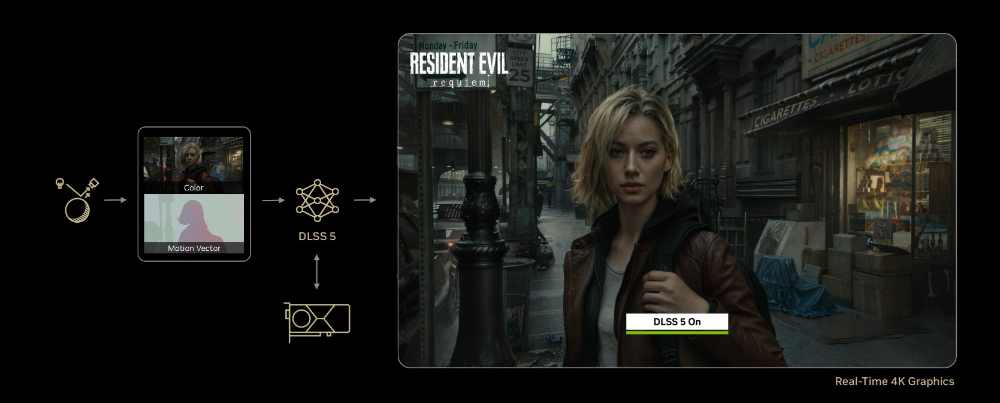
At GTC 2026 on March 16, NVIDIA introduced DLSS 5 — and it is a different kind of upgrade from every DLSS version before it. Previous iterations of DLSS focused on boosting frame rates: first through AI-based upscaling, then through frame generation that let the GPU manufacture entirely new frames between rendered ones. DLSS 5 changes the target entirely. Instead of making games run faster, it is built to make games look fundamentally more real.
The technology is called real-time neural rendering. It takes a game’s existing colour data and motion vectors for each frame and runs them through an AI model trained to understand what skin, hair, fabric, metal, and foliage actually look like under real-world lighting. The output: photorealistic lighting and material detail layered over the original game frame — in real time, at up to 4K resolution, frame-to-frame consistently, without altering the game’s original geometry or 3D assets.
NVIDIA CEO Jensen Huang described it at GTC as “the GPT moment for graphics.” DLSS 5 is confirmed for RTX 50-series GPUs (Blackwell architecture) and is set to arrive Fall 2026. Major publishers including Bethesda, CAPCOM, Ubisoft, Tencent, and Warner Bros. Games are already on board. This piece covers how it works, what is confirmed, what is still unknown — and where it fits in a decade of NVIDIA graphics progress. For broader AI and GPU context, see our coverage of the NVIDIA and Palantir Sovereign AI OS collaboration.
Key Numbers at a Glance
DLSS Through the Years
How DLSS Evolved — From Performance Tool to Visual Engine
Each DLSS generation arrived alongside a new GPU architecture — until DLSS 5, which breaks that pattern by releasing mid-cycle on existing Blackwell hardware.

DLSS 5 applied to Starfield. The model uses colour and motion vector data per frame as its only inputs, then adds lighting and material response anchored to the original 3D scene. Image: NVIDIA
The Technology — How DLSS 5 Works
Four Things to Understand About DLSS 5
🎨 Colour Buffer
The rendered frame’s raw colour data — exactly what the game engine produced. DLSS 5 does not see pre-rendered art or pre-baked textures. It works entirely from the live colour output of the frame.
📐 Motion Vectors
Per-pixel vectors describing how objects are moving between frames. These keep the neural output temporally stable — consistent from frame to frame — preventing flickering, ghosting, or artefacts.
Works Across All Rendering Methods
DLSS 5 accepts input from standard rasterised games, ray-traced titles, and fully path-traced games. The higher the quality of the input — for example, a path-traced frame rather than a rasterised one — the better the neural rendering output, because the model has more accurate lighting data to build from.
No new assets or materials are required from developers. The 3D geometry, textures, and art direction remain exactly as authored by the studio. Only lighting and material response are enhanced.
Scene Semantic Understanding
The AI model is trained end-to-end to identify what it is looking at within a single frame — human skin, hair, fabric, metal, foliage, glass, and more. Different material types receive different photorealistic treatment.
Material-Specific Processing
Skin: The model simulates subsurface scattering — the way light penetrates and diffuses beneath the surface, giving skin translucency rather than flatness.
Hair: Complex light-fibre interaction is modelled, the same physical process that gives hair its sheen and directional gloss.
Foliage: Opacity and depth complexity — how many layers of leaves sit at any pixel — are handled via opacity micro-map logic, something even path tracing struggles with at real-time speeds.
Lighting Condition Awareness
The model infers environmental lighting — front-lit, back-lit, overcast, or direct sunlight — from a single frame, then applies the correct photorealistic response to all materials in that frame. The output is deterministic: the same input always produces the same output, unlike generative AI, which produces bespoke results with every new prompt. This is a critical requirement for games.
✅ Real-Time at Up to 4K
DLSS 5 runs in real time, targeting smooth interactive gameplay at up to 4K resolution. It is integrated into DLSS frame generation — in the demo setup, every displayed frame was neural-rendered.
✅ Developer Artistic Controls
Developers can adjust intensity, apply colour grading, and use masking to exclude specific objects or regions from enhancement — so the AI result respects each game’s visual style and artistic intent.
✅ Geometry & Assets Unchanged
Original 3D geometry, textures, and character models are not altered or replaced. DLSS 5 applies lighting and material enhancements as a post-process layer on top of the rendered scene.
✅ Streamline SDK Integration
Uses the same NVIDIA Streamline framework already used by DLSS Super Resolution and NVIDIA Reflex. Studios already using DLSS face no new integration pipeline.
Hardware Compatibility — Not Yet Fully Confirmed
DLSS 5 has been demonstrated on RTX 50-series Blackwell GPUs. NVIDIA has not yet published an official GPU compatibility list. As of the GTC 2026 announcement, no statement has confirmed or ruled out partial support for RTX 40-series (Ada Lovelace) cards. NotebookCheck and VideoCardz both reported no announcement on older GPU support at time of reveal.
Dual-GPU Demos — Single GPU at Launch
GTC 2026 demos ran on two RTX 5090 GPUs in tandem — one rendered the game, one exclusively ran the DLSS 5 neural model. This was required because DLSS 5 is still in development and not yet optimised for VRAM footprint. NVIDIA confirmed the shipping version is designed for a single GPU. Computational cost scales with resolution, consistent with previous DLSS technologies.
Work in Progress — Fall 2026 Target
NVIDIA described the GTC demo as a “snapshot of current development.” Some screen-space rendering errors were visible in demo footage, noted by Digital Foundry in their hands-on preview. Three years of development at NVIDIA preceded the GTC reveal, per Digital Foundry’s reporting. Further optimisation and tuning are planned before the Fall 2026 launch.
Early Reception — Mixed
Initial public reaction to the demo footage was divided. Improvements to environmental lighting and foliage in games like Starfield and Assassin’s Creed Shadows were widely praised. Changes to character skin and facial appearance — particularly in Resident Evil Requiem — drew criticism from some quarters for altering original art direction. NVIDIA notes that developers retain full control via intensity and masking tools.
“Twenty-five years after NVIDIA invented the programmable shader, we are reinventing computer graphics once again. DLSS 5 is the GPT moment for graphics — blending handcrafted rendering with generative AI to deliver a dramatic leap in visual realism while preserving the control artists need for creative expression.”— Jensen Huang, Founder and CEO, NVIDIA — GTC 2026 Keynote
“NVIDIA and Bethesda have a long history of pushing gaming graphics and innovation forward, and DLSS 5 represents the next major step in that journey. With DLSS 5, the artistic style and detail shine through without being held back by the traditional limits of real-time rendering. We’re excited to work with this new technology and look to bring DLSS 5 to Starfield and future Bethesda titles.”— Todd Howard, Studio Head & Executive Producer, Bethesda Game Studios — NVIDIA Newsroom Press Release
“At CAPCOM, we strive to create experiences that feel cinematic, compelling and deeply believable — where every shadow, texture and ray of light is crafted with intention to enhance atmosphere and emotional impact. DLSS 5 represents another important step in pushing visual fidelity forward, helping players become even more immersed in the world of Resident Evil.”— Jun Takeuchi, Executive Producer & Executive Corporate Officer, CAPCOM — NVIDIA Press Release
“Immersion is about making the world feel real. DLSS 5 is a real step towards that goal. The way it renders lighting, materials and characters changes what we can promise to players. On Assassin’s Creed Shadows, it’s letting us build the kind of worlds we’ve always wanted to.”— Charlie Guillemot, Co-CEO, Vantage Studios (Assassin’s Creed Shadows) — NVIDIA Press Release
The Path Tracing Roadmap — And Why Moore’s Law Is No Longer Enough
At GDC 2026, NVIDIA VP of Developer & Performance Technology John Spitzer presented the numbers behind the company’s graphics roadmap. Starting from the Pascal architecture (GTX 10 series, launched April 2016 as the baseline), NVIDIA has delivered a 10,000× improvement in path tracing performance by the time of Blackwell (RTX 50 series, 2025). That gain does not come from transistor scaling alone. Spitzer stated directly: “Moore’s Law is dead. We are not going to see a 100× improvement in my lifetime in terms of silicon.”
The 10,000× figure is multiplicative — it combines 4th-generation RT cores, 3rd-generation Tensor Cores, DLSS 4.5’s AI inference (which handles 23 of 24 pixels), and algorithmic improvements. NVIDIA’s stated target for future GPUs — likely referring to the Rubin architecture, projected for a 2027–2028 window — is a 1,000,000× path tracing gain over Pascal. That target depends entirely on AI and algorithmic advancement, not silicon scaling. DLSS 5 is the first step in that direction.
Path Tracing Performance — Confirmed Milestones
From Pascal to Rubin — The Scale of GPU Advancement
NVIDIA has confirmed the Pascal (2016) baseline and the Blackwell 10,000× milestone. The 1,000,000× target is a future-GPU goal stated by NVIDIA. Intermediate figures are estimated, not officially published milestones.
Confirmed Games
15 Titles Confirmed for DLSS 5 Support at GTC 2026
Games confirmed in NVIDIA’s official GTC 2026 announcement. Highlighted titles were featured in the GTC 2026 demo sessions. Supporting publishers include Bethesda, CAPCOM, Hotta Studio, NetEase, NCSOFT, S-GAME, Tencent, Ubisoft, and Warner Bros. Games.
★ Highlighted titles were demonstrated live at GTC 2026. Full list as published in NVIDIA’s official announcement.
What Was Covered
NVIDIA announced DLSS 5 at GTC 2026 on March 16, 2026 as its most significant computer graphics advancement since real-time ray tracing debuted in 2018. The technology was presented as a real-time neural rendering model that takes colour data and motion vectors from a game frame as its only inputs and uses AI to apply photorealistic lighting and material response — running at up to 4K resolution on RTX 50-series Blackwell hardware. A Fall 2026 release was confirmed at the event.
The GTC 2026 presentation also covered the broader path tracing roadmap from NVIDIA VP John Spitzer, which placed current Blackwell GPUs at a 10,000× path tracing gain over the Pascal baseline from 2016, with a future GPU target of 1,000,000×. New path tracing technologies announced at GDC 2026 — ReSTIR for global illumination accuracy and updated RTX Mega Geometry — were presented alongside the DLSS 5 announcement as part of NVIDIA’s stated direction for graphics development. For related AI and hardware developments, see our coverage of NVIDIA’s Sovereign AI OS and AI applications in FIFA World Cup 2026.
The announcement, developer support, confirmed game list, DLSS evolution timeline, GPU roadmap numbers, and all quoted statements were sourced from NVIDIA’s official GeForce announcement and the NVIDIA Newsroom press release dated March 16, 2026.
Primary source: NVIDIA GeForce — DLSS 5 Announcement · NVIDIA Newsroom Press Release, March 16, 2026. Intermediate path tracing figures (Turing, Ampere, Ada Lovelace) are estimates; only Pascal baseline and Blackwell 10,000× are confirmed NVIDIA figures.