
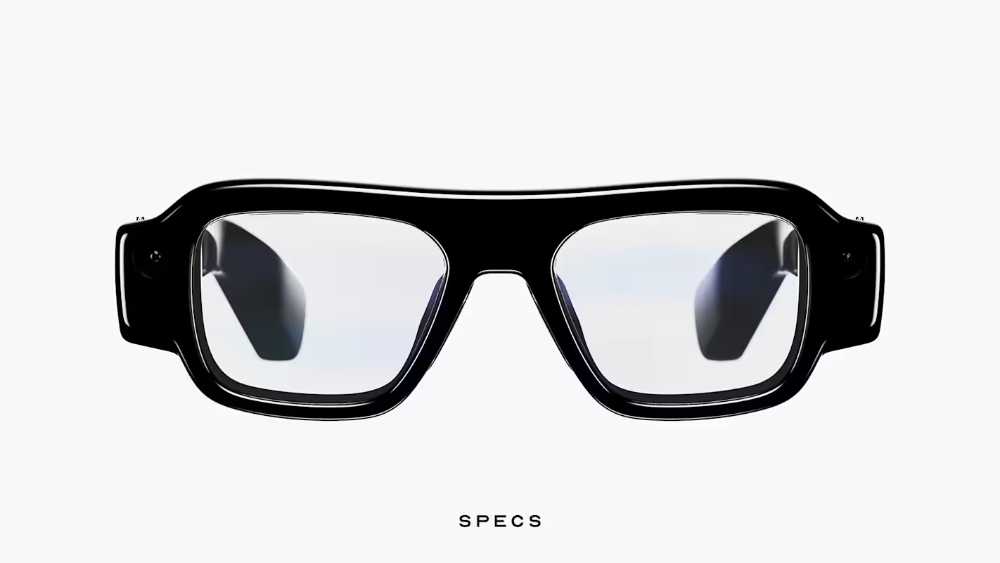
Snap has put a price on the future it has been building toward for more than a decade: $2,195. The company’s new Specs augmented reality glasses went up for pre-order this week, the first version of Snap’s AR hardware built for everyday buyers rather than developers. According to Snap’s official product announcement, the glasses are designed to project digital information, AI assistance, and shared experiences directly into a user’s field of vision without a phone, tether, or external compute pack.
Snap co-founder and CEO Evan Spiegel introduced Specs at the Augmented World Expo 2026 in Long Beach, California, framing it as a bet that people are ready to move computing off their phone screens. The glasses are available for pre-order now at SPECS.com for $2,195, with a $200 refundable deposit, and are expected to ship this fall in the United States, United Kingdom, and France.
What Specs is actually built to do
The pitch is straightforward: instead of pulling a phone out of a pocket, a Specs wearer sees directions, AI answers, translations, or a virtual whiteboard appear directly over what they’re already looking at. Snap describes this as computing that “fades into the background,” surfacing information only when it’s useful instead of demanding constant attention. The glasses run on Snap’s own operating system and pack two dedicated Qualcomm Snapdragon processors, one handling computer vision and the other running Lenses, Snap’s term for AR effects and apps.
The interactive breakdown below unpacks exactly what’s inside the frame, how the $2,195 price compares with rival AR and VR hardware, and how Snap got here after a decade of smart-glasses attempts that mostly failed to catch on.
What $2,195 actually buys you in Snap’s Specs
Snap is charging more for AR glasses than almost anyone else on the market. Tap into the hardware, see where the price sits against rivals, and trace how a decade of smart-glasses attempts led here.
Liquid crystal on silicon
Tap any glowing point on the frame to see what’s behind it
Why Snap is charging so much more than its last attempt
Spiegel has been direct about the gap between this device and Snap’s first hardware product. At $2,195 with a $200 refundable deposit, Specs are priced at more than 15 times the cost of Snap’s $130 camera-only Spectacles that debuted in 2016 and never became a hit. That original Spectacles model recorded short videos for Snapchat and never found a mass audience, eventually costing Snap close to $40 million in unsold inventory, according to reports from the time.
Spiegel has argued the new hardware reflects a different moment for the industry, telling CNBC that people are ready to think differently about where and how computing happens, moving it “off the phone and into the world around us.” He also framed Specs as a way to use computing together in shared experiences, looking through see-through lenses rather than at an opaque screen.
Not everyone is convinced the price will land well with consumers. Jitesh Ubrani, a research manager at IDC, told Reuters that the timing works against Snap, noting that “this is the worst possible time for any company to be launching any kind of premium product” given the current economic climate. He added that Snap’s audience skews younger than rivals like Apple or Meta, and that demographic “can’t afford to spend a lot” on premium hardware.
The competition isn’t waiting
Snap is not alone in betting on glasses as the successor to the smartphone. Meta’s Reality Labs has already built a real audience for its Ray-Ban Meta smart glasses, made in partnership with eyewear group EssilorLuxottica, after the company’s Quest VR headsets struggled to break out of a niche following. Google and Samsung have also entered the race, developing Android XR glasses in partnership with Warby Parker and Gentle Monster that are expected to feature AI-powered audio assistance. Spiegel has expressed skepticism about audio-only smart glasses, describing them as limited compared to full AR experiences with see-through displays.
Camera and sensor performance increasingly separate premium hardware from the rest of the pack, a dynamic also visible in devices like the Sony A7R VI, where stacked-sensor imaging defines the price tier. Apple’s Vision Pro, which starts at $3,500, remains the priciest mainstream face computer on the market and has not become the company’s next major consumer hit despite a large marketing push. Apple’s own AR glasses are still years from release.
Investors reacted before consumers got the chance to
Wall Street’s response to the announcement was immediate. Snap shares closed down 9.63% on the day Specs was revealed and continued falling in the following session, as investors weighed the price tag against years of losses tied to hardware spending. Snap has posted a net loss every year since becoming a public company in 2017, including a first-quarter 2026 net loss of $89 million even as revenue grew 12% year-over-year to $1.53 billion. The company has invested substantially in the Specs project, and activist investors have reportedly pushed Snap to consider whether the project should continue.
Spiegel has pushed back on that pressure directly, framing the spending as part of a long-term plan rather than a short-term product launch. Speaking to Reuters, he said that while investors may want more short-term profitability, Snap’s focus remains on driving long-term success. “We’ve been really clear with investors since we founded the company that we’re going to manage the business for the long term and really in service of our community and our customers,” Spiegel told Reuters. He added, “I think this is an important step for investors in the sense that they’ll see a lot of progress that they haven’t yet seen before, but it really is just another step.”
What Specs means for developers and AI tools
Snap is opening Specs to outside developers through Lens Studio, its AR development platform. Hundreds of Lenses have already been published for the device, and Snap reports that developers have been building for the platform over the past several years. Snap has also established partnerships with AI companies to bring contextual intelligence to AR experiences. A new developer preview adds agentic development tools that integrate with AI coding platforms, allowing developers to build AI-assisted Lenses directly inside their existing coding workflows. Snap is also introducing a Spatial Benchmark to test how AI models perform on real-world spatial tasks, a Migration Agent to help teams move existing projects onto Specs, and a Native Development Kit for bringing outside code and libraries into Lens Studio.
That kind of AI-assisted build pipeline mirrors a broader shift already underway in consumer computing, where tools like Google’s Gemini-powered laptop concepts are pushing AI deeper into everyday hardware rather than keeping it confined to a chat window. Snap has filed more than 7,000 patents across its augmented reality stack over the past decade, covering everything from developer tools and its operating system to displays, optics, and computer vision.
Privacy controls and child-safety features
Specs include an LED indicator that lights up while recording, and Snap says the glasses prioritize on-device processing, giving users control over what gets stored, synced, shared, or deleted. Snap has indicated it is developing additional parental controls for the platform. Spiegel, who has four sons, has spoken about the potential for AR glasses to create shared experiences for families, allowing children to play and learn together in the real world rather than staring at individual screens.
Audio playback and wearable comfort over long sessions remain open questions for any face-worn device, a concern that echoes ongoing comparisons in over-ear audio hardware such as the Sony WH-1000XM6 lineup, where battery life and comfort are similarly central to the buying decision.
A campaign built on culture, not specs sheets
To accompany the launch, Snap is running a global Specs campaign photographed by Steven Meisel, featuring five people the company calls “Visionaries”: Golden State Warriors forward Jimmy Butler, singer-songwriter Imogen Heap, actress and model Hoyeon, rapper Jack Harlow, and model Kaia Gerber. Each is featured in the campaign, which spans sports, music, fashion, and entertainment.
Wearable health and fitness tracking has expanded alongside devices like this, with products such as the Oura Ring 5 reflecting the same trend toward hardware that tracks personal data throughout the day.
What this launch covered
Snap’s announcement covered the price, release window, hardware specifications, developer tools, and privacy features tied to the Specs launch. The company detailed a pre-order period that opened immediately, a fall 2026 shipping target for the United States, United Kingdom, and France, and a marketing campaign introducing the device alongside the launch. Spiegel’s remarks on long-term strategy, the IDC and investor commentary, and the stock movement following the announcement were also part of the coverage. For background on related hardware launches, see Giganectar’s coverage of the HyperX Omen 16 and the AMD Ryzen AI laptop benchmark comparison.