
The World’s Smallest Smart Ring
Is Also the Most Capable
Oura Ring 5 launched on 28 May 2026, and it is 40% smaller than its predecessor by volume — yet it tracks more, lasts longer, and costs more too. At just 2.28 mm thick and 6.09 mm wide, it is the smallest smart ring Oura has ever built. Pre-orders are live now, with shipping starting 4 June 2026.
The Ring 5 arrives as Oura moves beyond sleep tracking into proactive health monitoring, pairing new hardware with software designed to catch cardiovascular patterns, breathing disturbances, and medication effects — all from a ring that is meant to feel like jewellery. According to Oura’s own engineering team, the company rebuilt the electrical, optical, battery, and sensing architectures from scratch to achieve this size without losing accuracy. If anything, accuracy went up.
If you are weighing up wearables in 2026, here is everything you need to know — hardware, software, pricing, and what is genuinely new — explored interactively below. For broader context on the wearables landscape, see our coverage of the Google Fitbit Air and Sony’s 1000X Collexion.
Tap a category to see how Ring 5 stacks up against Ring 4 across dimensions, accuracy, battery, and price. Numbers sourced from Oura’s official announcements.
*Ring 4 used 18 multi-wavelength PPG paths. Ring 5 uses 12 redesigned pathways, with individually stronger and more efficient signals.
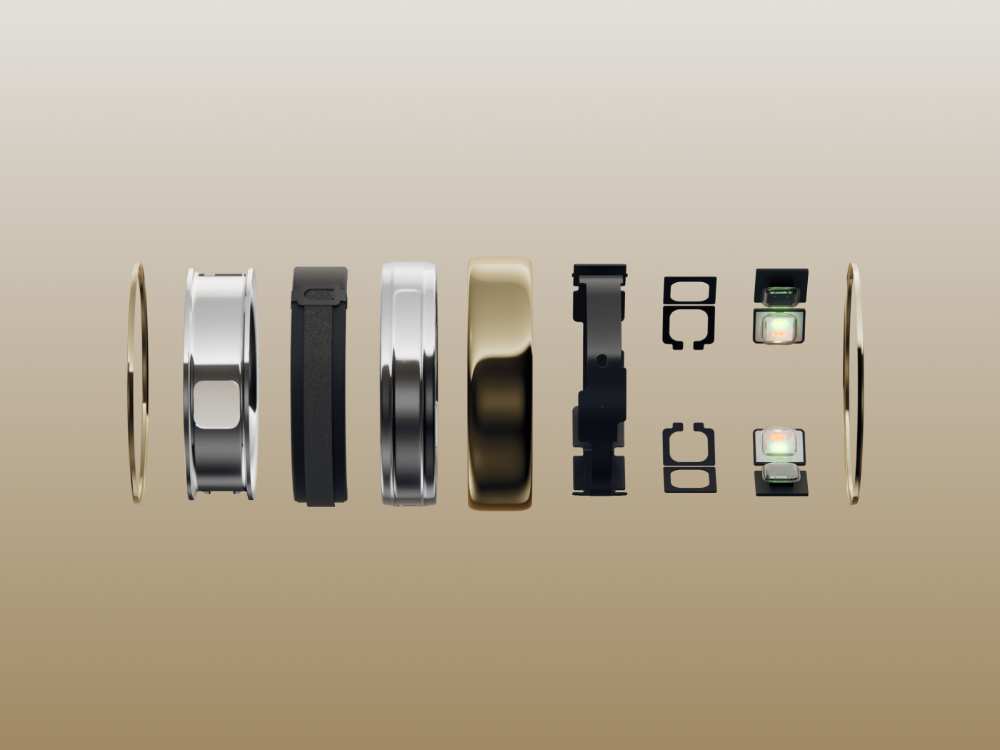
Oura achieved the Ring 5’s slimmer dimensions not by trimming a single component, but by redesigning all five core architectures in parallel: mechanical, electrical, optical, battery, and sensing. The company’s industrial design team, led by Staff Industrial Designer Mikko Aarras, found that 6 mm was the preferred width across research with a broad range of people — wide enough to be functional, narrow enough to disappear on the finger. Working backward from that target forced changes in every subsystem simultaneously.
The sensing overhaul is the most technically involved part. Oura’s Ring 4 used 18 multi-wavelength photoplethysmography (PPG) pathways. Ring 5 has 12 — fewer paths, but each one redesigned for higher signal quality. The LEDs were rotated 180 degrees to shorten the optical paths for red, infrared, and green light, and the photodiode component was made larger. The result, per Principal System Engineer J-T Mäkinen, is that “the design balances signal strength and quality with the ability to drive LED chips with lower currents, meaning less power consumption” — which in turn supports longer battery life.
The sensor domes are now 0.7 mm tall (versus 0.3 mm in Ring 4), which places them closer to the skin and through the metallic layer for better contact. A flat-top design keeps them comfortable despite the added height. According to Oura’s engineering breakdown, overnight HRV accuracy is 12% better than Ring 4, workout heart-rate signal quality is 24% better, and top-activity workout HR accuracy improved by 19%. Titanium construction with physical vapor deposition (PVD) coating is retained, providing scratch resistance and hypoallergenic wear comfort.
“We rebuilt Oura Ring from the inside out to deliver more accurate, continuous insights in a smaller, lighter, more comfortable ring — so people can focus on living their lives, not tracking them.”
— Tom Hale, CEO, OuraRing 5 launches alongside a major software update called Health Radar, available on Ring 5 as well as Ring Gen 3 and later. It monitors biometric data continuously and surfaces patterns that may need attention — before they become obvious. Explore each feature below.
Additional software rolling out alongside Ring 5 includes Live Activity Tracking (real-time pace, distance, and HR during workouts), improved Automatic Activity Detection for low-motion activities like Pilates, Health Records (import diagnosed conditions, medications, lab results, and allergies into the app — US only), and a Brain Health Study that matches short in-app tasks with long-term physiological trends for eligible members.
This piece covered the launch of Oura Ring 5 — its dimensions (6.09 mm wide, 2.28 mm thick, starting from 2 g), the engineering changes that achieved a 40% volume reduction against Ring 4, the improved sensor accuracy figures, and the expanded software suite launching alongside it.
Pricing, finish options, subscription costs, the Counsel Health care partnership, Blood Pressure Signals, Nighttime Breathing, GLP-1 Insights, and the company’s broader IPO trajectory were also covered. Ring 5 is available for pre-order at ouraring.com, with shipping from 4 June 2026.
For more wearables and tech coverage on Giganectar, see our pieces on the Google Fitbit Air, Sony 1000X Collexion, iPhone Ultra Foldable, iPhone 18 Pro pricing analysis, and the Sony A7R VI specs breakdown.