
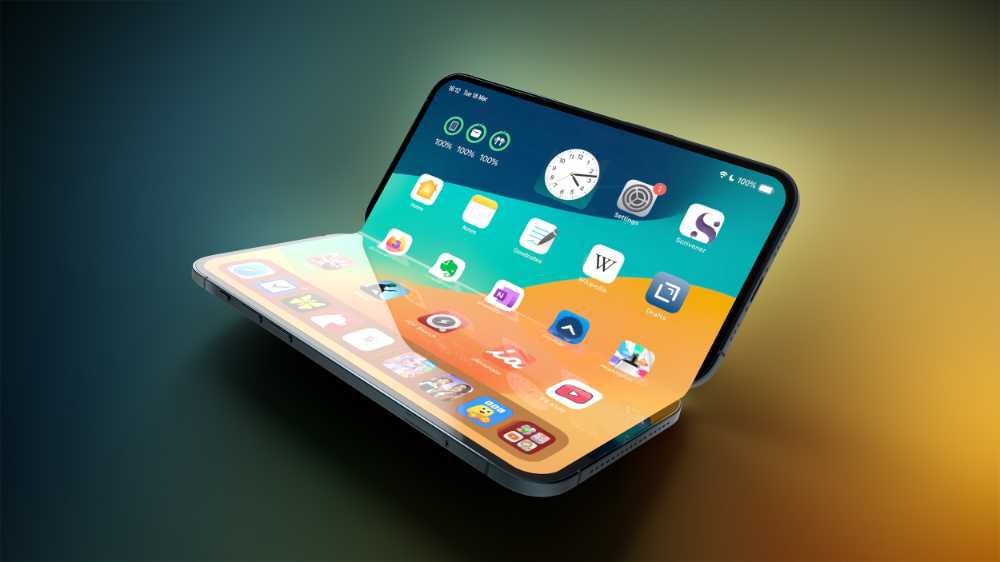
iPhone Ultra Starts at $1,999 with No Face ID — Gurman Says It Will “Cross the $2,000 Threshold” This September

GigaNectar Team

Multiple purple iPhone Ultra dummy units shown in closed and partially open positions on a wooden surface, displaying the wide passport-style form factor and dual rear camera module layout expected on Apple's first foldable phone.

Apple has been rumoured to be working on a foldable iPhone since at least 2018. What was once dismissed as distant speculation has, as of 2026, moved into full engineering validation and trial production at Foxconn. The device — now widely referred to as the iPhone Ultra — is expected to arrive alongside the iPhone 18 Pro in September 2026, though some analysts put broad availability closer to December.

The announcement alone — before a single unit ships — has already changed how the foldable phone market looks in 2026. Samsung is launching the Galaxy Z Fold 8 Wide, a first-ever wide-format foldable from the Korean giant. Huawei has followed with the Pura X Max. The wide “passport” shape, which Apple is expected to use, has become the new template. Here is what is confirmed, what is rumoured, and what it all means for buyers right now.

Folded, Wider, Pricier: Inside the iPhone Ultra Spec Sheet

7.8″
Inner Display (rumoured, unfolded)
4.5mm
Thickness when unfolded
$1,999+
Expected starting price (USD)
5,000–5,500 mAh
Reported battery capacity
A20
Expected chip (2nm)
2×48MP
Rear cameras — no telephoto
How the 2026 Wide Foldables Stack Up
Tap a device to compare specs. All figures are from leaks and analyst reports — nothing is officially confirmed by Apple.
Apple
iPhone Ultra (rumoured)
Inner display 7.8″ OLED
Outer display 5.5″
Aspect ratio 4:3 (iPad-like)
Chip A20 (2nm)
RAM 12 GB
Rear cameras 2 × 48MP (no telephoto)
Battery 5,000–5,500 mAh (Li-ion likely)
Biometrics Touch ID (no Face ID)
Folded thickness ~9.5mm
Unfolded thickness ~4.5mm
Starting price (USD) $1,999–$2,399
OS iOS 27 (no iPadOS)
Context
Key Trade-offs
No Face ID First iPhone without it
No telephoto Space constraints cited
No iPadOS Custom iOS 27 layouts
Silicon-carbon battery Not confirmed for this model
Crease Reduced via variable-thickness glass
Hinge material Titanium alloy
Modem Apple C2 (in-house)
Expected supply Limited at launch (3–5M units)
Samsung
Galaxy Z Fold 8 Wide (leaked)
Inner display 7.6″ OLED
Outer display 5.4″
Aspect ratio 4:3 (inner)
Chip Snapdragon 8 Elite
Rear cameras 2 (no telephoto leaked)
Battery ~4,800 mAh
Folded thickness ~9.8mm
Unfolded thickness ~4.3–4.9mm
Expected price (USD) ~$2,000
Expected launch July 2026 (Unpacked)
Si-C battery Still under evaluation
Context
What’s Different About the Wide
Why it exists Direct response to iPhone Fold
Proportions Shorter & wider than Z Fold 7
Production target ~1 million units
Letterboxing improvement Yes — 4:3 fits video better
S Pen support Rumoured, unconfirmed
Huawei
Pura X Max
Form factor Wide / widescreen foldable
Battery tech Silicon-carbon (Si-C)
Historical note Huawei’s first widescreen foldable
Advantage Higher energy density vs Li-ion
Availability Primarily China market
Silicon-Carbon Battery Edge
Why Si-C Matters in Foldables
Energy density gain Up to 20% vs standard Li-ion
Same physical size More power, same footprint
Screen-on time gap ~3–4 hrs more vs Li-ion devices
Apple / Samsung status Testing — not adopted yet

The Battery Gap Nobody’s Talking About

Large foldable displays are power-hungry by nature. The battery technology inside these phones will decide which ones actually last a full day. Here’s the divide between silicon-carbon and conventional lithium-ion, and which 2026 foldables fall on each side.

Silicon-Carbon
Huawei Pura X Max & Honor Magic V6
Silicon-carbon anodes deliver up to 20% higher energy density within the same physical size as a conventional cell
📱
Real-world screen-on times of 10+ hours reported on Si-C devices like the Oppo Find X9 Pro — roughly 3–4 hours more than lithium-ion equivalents
🔧
Flexible coatings now manage silicon’s natural expansion and contraction, improving long-term stability
Also confirmed in Motorola Razr Fold for 2026
Lithium-Ion (Standard)
iPhone Ultra & Galaxy Z Fold 8 Wide (expected)
🔋
iPhone Ultra rumoured at 5,000–5,500 mAh — the largest battery ever in an iPhone, but likely standard Li-ion
⚠️
Samsung has stated it is testing silicon-carbon safety but has not adopted it in a shipping foldable yet
🍎
Apple is not expected to introduce a new battery chemistry alongside an entirely new device category on its first try
📊
Foldable global shipments grew 14% year-on-year in Q3 2025 to an all-time quarterly record, per industry data
From Rumour to Reality: The iPhone Foldable Timeline
Key milestones in Apple’s long road to a foldable phone
2018
Reports first surface suggesting Apple is exploring a foldable iPhone, with a target of 2020. The project stalls repeatedly.
March 2025
Analyst Ming-Chi Kuo reports Apple is exploring LiquidMetal for the hinge to improve flatness and minimise crease marks.
July 2025
Kuo reports Apple has developed a solution to eliminate the visible fold crease using metal plates to distribute bending stress.
Late 2025
Device moves into engineering verification and pre-production (EVT) phase. Supply chain reports show Apple increased display orders from Samsung to 20 million units.
Feb 2026
Weibo leakers report a 5,000–5,800 mAh battery. Volume buttons placed on the top edge. Two rear cameras confirmed in a narrow “plateau” camera bar, similar to the iPhone Air.
March 2026
Mark Gurman (Bloomberg) confirms the foldable will run iOS 27 — not iPadOS — and will be among Apple’s “Ultra” product line. The name “iPhone Ultra” is widely circulated.
April 2026
Nikkei Asia reports engineering setbacks. Gurman responds that Apple remains on track for a fall 2026 debut. Trial production is confirmed at Foxconn. Dummy models go public, confirming the wide “passport” shape.
Sep 2026 (Target)
Expected announcement alongside iPhone 18 Pro and Pro Max. Barclays analyst Tim Long suggests shipments may begin in December. Supply shortages at launch are widely anticipated.
What Buyers Are Asking
Answers based on current leaks and analyst reports — not official Apple statements
Will it actually have no visible crease? +
Apple is using variable-thickness glass — thinner precisely at the fold point — combined with an optically clear adhesive to reduce stress on the panel. Earlier leaks described it as “crease-free.” A later MacRumors report clarified that the technology reduces the crease without eliminating it entirely. Apple reportedly pursued the solution “regardless of cost,” suggesting it will be significantly less visible than competing foldables.
Why does it use Touch ID instead of Face ID? +
Both Ming-Chi Kuo and Mark Gurman have independently confirmed that Face ID is absent from the foldable iPhone. The device requires two separate front-facing cameras — one for the outer display and one for the inner — and fitting the full Face ID sensor array into an ultra-thin 4.5mm chassis is not feasible in the first generation. Touch ID is integrated into the power button, the same approach used on the iPad Air.
Why no telephoto camera? +
Multiple sources confirm the dual 48MP setup with no telephoto on the rear. The chassis, at 4.5mm when unfolded, leaves no physical room for a telephoto module. The two cameras — a standard wide and an ultrawide — sit on a long, thin camera bar on the back, described as similar to the iPhone Air’s layout, finished in black rather than colour-matched to the body.
What software will it run? +
The iPhone Ultra will run iOS 27, confirmed by Gurman in March 2026. It will not run iPadOS. There will be no Stage Manager or full desktop-style windowing. What it will include: iPad-like app layouts with sidebars when open, split-screen for two apps side by side, and smooth transitions between the outer and inner display. Third-party app adaptation at launch is an open question — developers will have tools to optimise for the 4:3 canvas, but coverage will be uneven early on. For more on Apple’s broader 2026 hardware plans, see our coverage of the MacBook Pro M5 and MacBook Neo.
How does it compare to the Samsung Galaxy Z Fold 7? +
The Galaxy Z Fold 7, launched in July 2025, is the benchmark the iPhone Ultra will be measured against. It has seven generations of foldable software refinement behind it, a full telephoto camera, and Face ID equivalents on Android. The iPhone Ultra’s iOS 27 foldable interface is version 1.0. Apple has the developer leverage to close the software gap, but it will not be closed on day one. On hardware, the iPhone Ultra is expected to be thinner when unfolded (4.5mm vs the Fold 7’s 4.2mm is comparable) and its crease-reduction technology is reportedly more aggressive.
Should I buy one at launch? +
Supply will be limited. Analyst Ming-Chi Kuo projected 3–5 million units shipping in 2026, with broader availability in 2027. A second-generation model is widely expected in 2027, timed around the iPhone’s 20th anniversary, and is likely to have a more mature software ecosystem, wider app support, and possibly silicon-carbon battery technology. For most people, the second generation will address the first-generation compromises. Apple has confirmed nothing about this device. All specifications remain rumoured. Also worth reading: our notes on the AirPods Max 2 as part of Apple’s wider 2026 product cycle.

This piece covered the rumoured specifications, design decisions, and market context surrounding Apple’s first foldable phone — referred to in leaks as the iPhone Ultra. The device’s expected wide “passport” shape, pricing above $2,000, and September 2026 target launch window were discussed, alongside the engineering challenges that have put the timeline under pressure.

The arrival of the Galaxy Z Fold 8 Wide, Huawei Pura X Max, Honor Magic V6, and Motorola Razr Fold as wide-format rivals was covered, including the silicon-carbon battery advantage held by several of those Android devices. The trade-offs in the iPhone Ultra’s design — including the absence of Face ID, the lack of a telephoto camera, and the use of iOS 27 rather than iPadOS — were also addressed based on current leaks and analyst reports.

For the latest on Apple’s 2026 hardware cycle, see our coverage of the iPhone 18 Pro colour changes and Apple’s software ecosystem updates. Apple has not confirmed any of the specifications discussed in this piece.


Leave a comment