
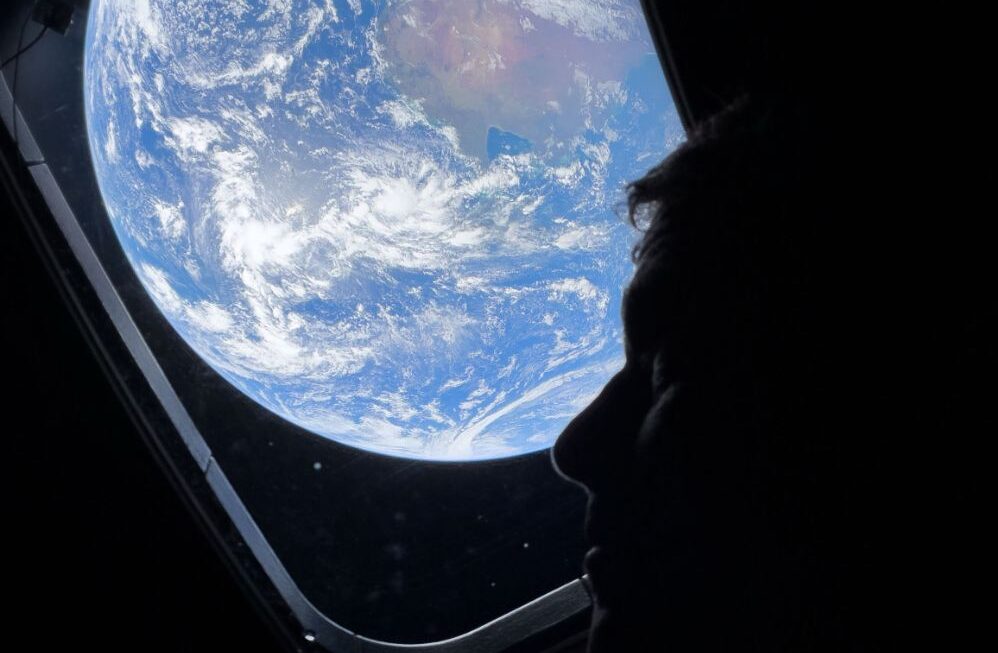
Earth Setting Behind the Moon — Shot on an iPhone
NASA Artemis II Commander Reid Wiseman posted the first-ever video of an Earthset, captured on an iPhone 17 Pro Max through a narrow docking hatch window, days after the crew’s safe return to Earth.
On April 19, 2026, NASA astronaut Reid Wiseman posted a video on X showing Earth slowly disappearing behind the Moon — an event called an Earthset. What made the clip different from anything we had seen before was the device used to film it: an iPhone 17 Pro Max, pressed against the narrow glass of the Orion spacecraft’s fifth docking hatch window. The video is uncropped, uncut, and shot at 8x zoom.
Wiseman described why he reached for his phone rather than professional gear. Through the tight docking hatch window, larger equipment would not have fit. The iPhone, he wrote, was “the perfect size to catch the view.” In the background of the clip, you can hear the rapid shutter clicks of a Nikon camera — that was mission specialist Christina Koch, shooting 3-shot bracket stills through a 400mm lens at a nearby window. The Artemis II crew splashed down safely in the Pacific Ocean off San Diego on April 10, 2026, completing a nearly 10-day lunar flyby mission. The iPhone video was posted by Wiseman ten days after their return.
Artemis II: Mission by the Numbers
The key facts from NASA’s first crewed Artemis flight, the first crewed mission beyond low Earth orbit since Apollo 17 in 1972.
The Artemis II Crew
Four astronauts. One spacecraft named Integrity. The first humans to fly toward the Moon since Apollo 17 in 1972.
Only one chance in this lifetime… Like watching sunset at the beach from the most foreign seat in the cosmos, I couldn’t resist a cell phone video of Earthset. Uncropped, uncut with 8x zoom — quite comparable to the view of the human eye.
What the Crew Was Shooting With
Two devices, two vantage points. The Orion spacecraft carried both professional camera gear and iPhones for documentation.
- 8x optical zoom used for the Earthset clip
- Filmed uncropped and uncut through the docking hatch window
- Compact form factor was key — larger gear would not fit the narrow hatch glass
- Video duration approximately 50 seconds
- The Artemis II crew carried iPhone 17 Pro Max units alongside professional cameras
- Used by Christina Koch for Earthset still photography
- Shot 3-bracket exposures to handle challenging deep-space lighting
- 400mm focal length for detailed lunar surface framing
- The Nikon shutter sound is audible in Wiseman’s iPhone video
- The Earthset still image was captured at 22:41 UTC on April 6, 2026
Mission Context
Key background on the Artemis II mission and what the Earthset moment means in space exploration history.
What Was Covered Here
This piece covered the Earthset video posted by NASA Artemis II Commander Reid Wiseman on April 19, 2026 — filmed on an iPhone 17 Pro Max through the Orion spacecraft’s fifth docking hatch window during the mission’s lunar flyby on April 6, 2026. The mission and its crew — Wiseman, Victor Glover, Christina Koch, and CSA astronaut Jeremy Hansen — were discussed in the context of the approximately 10-day mission, which ended with splashdown in the Pacific Ocean off San Diego on April 10, 2026. The crew’s camera equipment, the circumstances of the filming, and the background of the Artemis II mission were covered.
For more tech and space-related coverage, see Giganectar’s reports on Google Gemini’s macOS app, the April 2026 Microsoft Patch Tuesday, and Netflix’s latest platform changes.