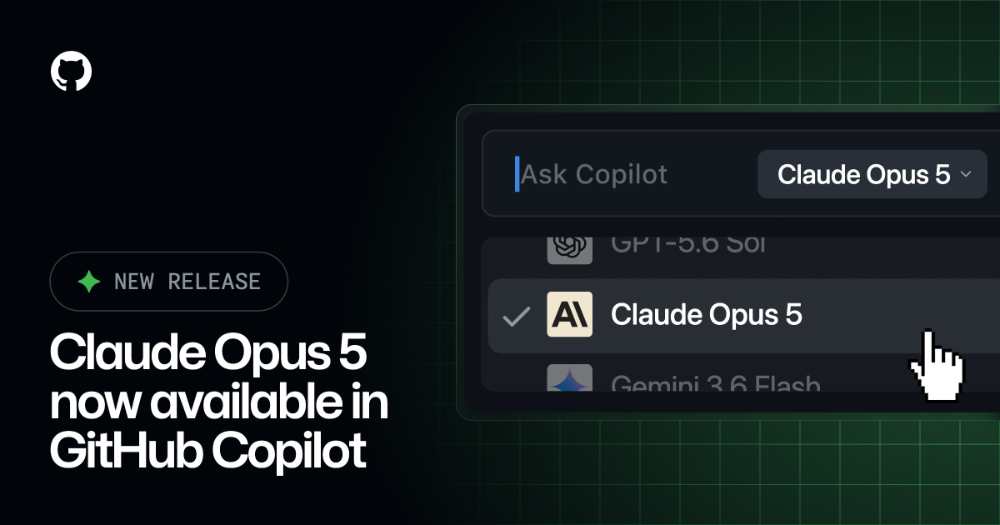
Anthropic’s Claude Opus 5 AI model became available through GitHub Copilot on July 24, 2026, expanding developer access to advanced AI reasoning capabilities through an established platform. This integration represents a major distribution milestone for Anthropic and signals continued diversification of AI model providers within Microsoft’s developer tooling ecosystem.
Claude Opus 5 was specifically designed for complex, multi-step coding tasks requiring careful reasoning and effective tool coordination. The model excels at agentic workflows—autonomous problem-solving sequences where the AI breaks down complex tasks, plans solution steps, and executes coordinated actions with minimal human supervision. Unlike traditional code completion that suggests individual lines or functions, Opus 5 can autonomously make targeted code changes, validate modifications, and reduce unnecessary execution overhead.
Agentic AI capabilities transform how developers approach complex coding problems. Rather than requesting single functions or snippets, developers can describe multi-step requirements and let Opus 5 handle implementation, testing, and validation autonomously. This represents a fundamental shift from AI as a productivity multiplier within existing workflows to AI as an autonomous agent executing substantial development tasks independently. Claude’s previous coding models already set benchmarks in agentic performance, and Opus 5 pushes further.
GitHub Copilot integration proves strategically valuable for both Microsoft and Anthropic. GitHub hosts millions of developers, making Copilot one of the most widely-used AI-assisted coding platforms. Integrating Opus 5 gives these millions of developers immediate access to Anthropic’s most capable model without requiring platform switching. For developers, having Opus 5 available in existing tools reduces friction—they can access advanced AI reasoning within their normal development environments without learning new interfaces.
The integration addresses limitations in previous Copilot offerings. GitHub previously relied on OpenAI’s GPT models for Copilot functionality. Adding Opus 5 as an option gives developers choice between different AI models. Studies have shown developers already favor Anthropic’s Claude over OpenAI Codex for complex coding tasks, making this integration a natural evolution.
Performance testing showed Opus 5 delivering particularly strong results on agentic coding benchmarks—tasks requiring multi-step problem-solving and tool coordination. The model effectively handles regression verification, automatically testing code changes to identify unintended side effects. This automated validation reduces bugs and improves code quality compared to unaided manual development. Claude Opus 5 achieves state-of-the-art performance on SWE-bench and other coding evaluations.
Safety features distinguish Opus 5 from some competing models. Anthropic implemented enhanced safeguards against high-harm cyber content, blocking some cybersecurity-related requests. This design choice reflects Anthropic’s philosophy of building AI systems with built-in safety considerations. While some developers might occasionally need to work on security-sensitive code, the safeguards reflect responsible AI deployment practices.
The integration also demonstrates Anthropic’s strategic approach to AI model distribution. Rather than building a standalone developer platform from scratch, Anthropic leverages Microsoft’s established GitHub infrastructure. This approach accelerates user adoption and requires far less engineering overhead. Developers already using GitHub Copilot simply gain access to Opus 5 without changing tools or workflows.
Microsoft’s willingness to integrate Anthropic’s models represents strategic diversification for GitHub. Relying exclusively on OpenAI creates competitive risk—OpenAI could build competing products or change licensing terms. Integrating multiple model providers reduces vendor lock-in and ensures GitHub remains the developer’s choice regardless of model preferences.
The availability timing aligns with accelerating AI model development. New capable models launching regularly means developers increasingly expect choice between models optimized for different tasks. Opus 5 availability through Copilot lets developers leverage Anthropic’s latest capabilities immediately upon release without waiting for indirect distribution through third parties. Claude Sonnet 4 already rivals GPT-4.1 and Gemini 2.5 Pro on benchmarks, and Opus 5 raises that bar further.
Enterprise adoption implications are significant. Companies evaluating AI-assisted development platforms can now pilot Anthropic’s models through GitHub Copilot rather than requiring separate infrastructure. This accessibility accelerates enterprise AI adoption and provides competitive advantages for organizations moving fastest toward AI-augmented development practices.