On March 17, 2026, OpenAI released GPT-5.4 mini and GPT-5.4 nano — two compact, faster versions of its flagship GPT-5.4 model, designed for high-volume workloads where response speed is as critical as raw capability. GPT-5.4 mini runs more than twice as fast as its predecessor GPT-5 mini, scores 54.38% on SWE-bench Pro (just 3.3 points behind the flagship’s 57.7%), and is now accessible to ChatGPT Free and Go users via the “Thinking” option in the + menu.
GPT-5.4 nano is OpenAI’s lowest-cost model to date at $0.20 per million input tokens, available exclusively through the API. Both models are built to operate as subagents inside agentic AI systems — where a larger model like GPT-5.4 orchestrates and delegates individual tasks to mini and nano running in parallel. GPT-5.4 mini is also now rolling out in GitHub Copilot for Pro, Pro+, Business, and Enterprise users. Notion’s AI Engineering Lead Abhisek Modi noted: “Until recently, only the most expensive models could reliably navigate agentic tool calling. Today, smaller models like GPT-5.4 mini and nano can easily handle it.”
Faster, cheaper AI built for subagents — GPT-5.4 mini scores 54.38% on SWE-bench Pro, within 3.3 points of the flagship, at a fraction of the cost and more than 2× the speed.
By the numbers
Key figures at a glance
All benchmark scores are from the official OpenAI release, run at high reasoning effort.
Benchmarks
How the three models compare
SWE-bench Pro tests real software-engineering tasks. OSWorld-Verified measures autonomous desktop navigation via screenshots.
Source: OpenAI official release, March 17, 2026 · High reasoning effort · Human OSWorld baseline: 72.4%
Model explorer
Pick a model, see the full specs
Tap any model below to see its specs, benchmark scores, pricing, and where it’s available right now.
GPT-5.4 mini
Fast, capable, and on ChatGPT’s free tier
GPT-5.4 nano
API-only · OpenAI’s lowest price point
GPT-5.4 flagship
Full capability — plans, coordinates, reviews
How agentic AI works
The delegation model, explained
Inside Codex, GPT-5.4 acts as the orchestrator. It decides what needs to be done, then hands individual jobs to mini and nano running in parallel — each handling narrower, faster tasks.
“For editing pages specifically, it matched and often exceeded GPT-5.2 on handling complex formatting at a fraction of the compute.” — Abhisek Modi, AI Engineering Lead, Notion (via OpenAI’s official release)
Availability
Who can access what, right now
GPT-5.4 mini is the more widely available model. GPT-5.4 nano is restricted to the API and targets developer pipelines.
GPT-5.4 mini
- ChatGPT Free & Go — “Thinking” in + menu
- Paid users — fallback when GPT-5.4 Thinking hits rate limit
- OpenAI API
- Codex — uses 30% of GPT-5.4 quota
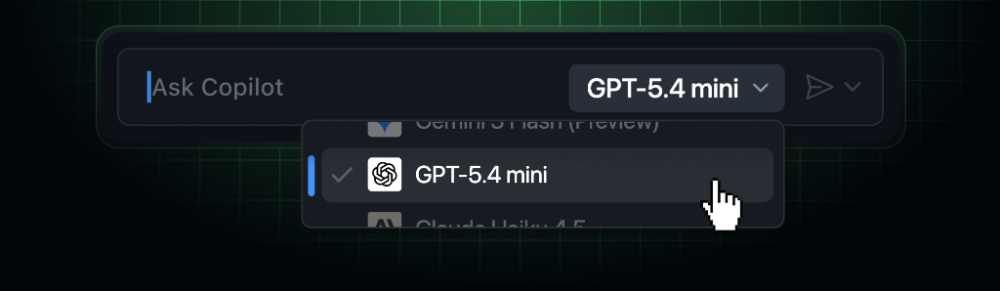
- GitHub Copilot — Pro, Pro+, Business, Enterprise
GPT-5.4 nano
- OpenAI API only
- Not in ChatGPT interface
- Not in Codex UI
- For developer pipelines & automated workflows
- $0.20 per 1M input tokens
Developer tooling
GPT-5.4 mini lands in GitHub Copilot
Enterprise and Business admins must first enable the GPT-5.4 mini policy in Copilot settings before it appears in the model picker for their users.
Available across all major IDEs
Now rolling out per the GitHub Copilot changelog. Select it via the model picker in chat, ask, edit, and agent modes. A 0.33× premium request multiplier applies — pricing is tentative and subject to change.
Cost
API pricing at a glance
Prices are per million tokens as listed in the official OpenAI release.
GPT-5.4 mini
GPT-5.4 nano
Wrap-up
Small Models, Serious Specs
This piece covered the benchmark scores, pricing, availability, and agentic workflow role of GPT-5.4 mini and GPT-5.4 nano, both released by OpenAI on March 17, 2026. GPT-5.4 mini scored 54.38% on SWE-bench Pro and 72.13% on OSWorld-Verified — within striking range of the flagship’s 57.7% and 75.0% respectively, running more than twice as fast as GPT-5 mini. GPT-5.4 nano, at $0.20 per million input tokens, is OpenAI’s most affordable model and is API-only.
GPT-5.4 mini is available in GitHub Copilot for Pro, Pro+, Business, and Enterprise plans, as well as ChatGPT’s free tier, Codex, and the OpenAI API. In Codex, the model uses 30% of the GPT-5.4 quota, making it practical for routine coding workflows. GPT-5.4 nano is aimed at pipelines handling classification, extraction, and ranking at scale. All pricing, benchmark data, IDE support, and access details discussed here were drawn directly from OpenAI and GitHub’s official release materials.
For more recent technology coverage, see: NVIDIA DLSS 5 and neural rendering for RTX 50 series, Google Maps’ Gemini AI navigation update, and AirPods Max 2 specs, pricing, and features.