
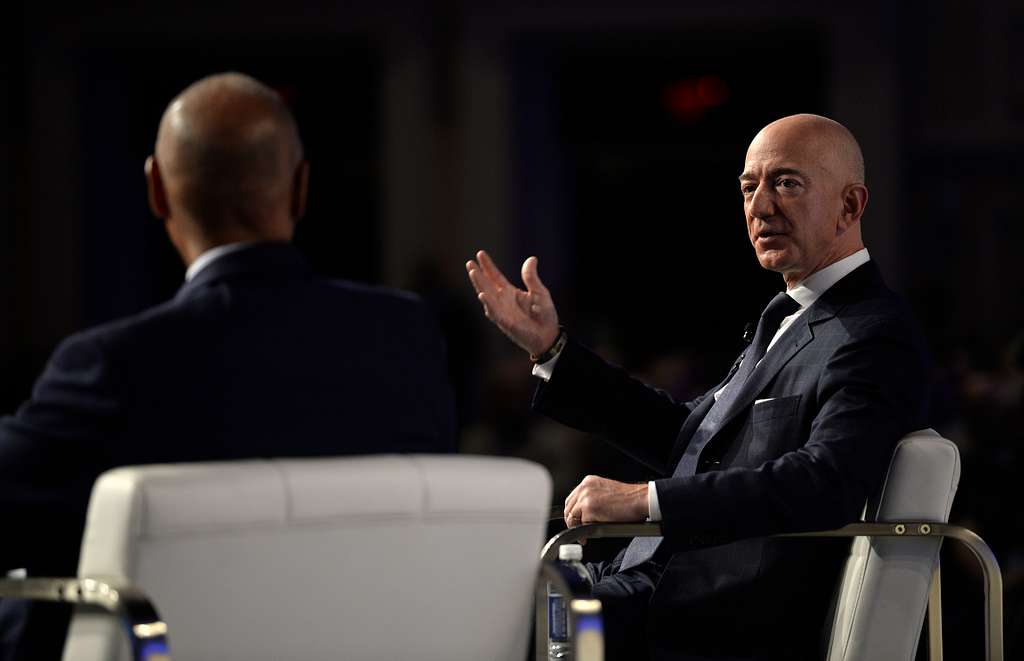
Speaking live from Blue Origin‘s rocket facility in Florida on May 20, 2026, Amazon founder Jeff Bezos addressed CNBC’s Andrew Ross Sorkin on “Squawk Box” with a straightforward message: the AI investment surge, bubble or not, is not something to worry about. His comments came as hyperscalers including Amazon, Microsoft, and Google are collectively on track to spend over $700 billion on AI infrastructure in 2026, according to industry projections.
Bezos, who stepped down as Amazon’s CEO in 2021 and remains its executive chairman, offered a comparison to the biotech bubble of the 1990s. That period saw a market frenzy followed by a crash — but also produced life-saving drugs that are still in use today. He argued that AI spending will follow a similar path, where the winners pay for the losers, and civilization keeps the technology either way. Much of his current focus spans three projects: Amazon, Blue Origin, and his new startup, Project Prometheus.
The $700 Billion Question: Are We in an AI Bubble?
“Even if it does turn out to be a bubble, you shouldn’t worry about it because the bubble is driving investment and a lot of the investment is going to turn out to be very healthy.”
— Jeff Bezos, CNBC Squawk Box, May 20, 2026
What Are Tech Leaders Saying?
Tap a name to see their position on the AI investment debate
Project Prometheus: Bezos’ Bet on Physical AI
Launched in November 2025, Project Prometheus is Bezos’ most significant operational role since leaving Amazon. The company is focused on what the industry calls “physical AI” — models trained on real-world engineering data, robotics interactions, and manufacturing workflows. Bezos describes it as building an “artificial general engineer” — a very modern version of CAD software. Co-led with Vik Bajaj, a former director at Google X who co-founded Alphabet’s Verily, the startup has hired from OpenAI, DeepMind, and Meta. Bezos chose to keep it separate from both Amazon and Blue Origin, saying it “deserves its own special focus.”
The AI Investment Cycle — A Timeline
AI and the Workforce: What the Numbers Say
Bezos said AI will act as a bulldozer, not a replacement. But workforce data tells a more complex story. According to Business Insider’s Alastair Barr, tech roles have jumped 30% so far in 2026. Meanwhile, entry-level hiring has dropped sharply at major firms since 2025. The data sits between Bezos’ optimism and Amodei’s warning — and both figures are factual. Here’s a snapshot:
Bar widths are proportional for visual comparison, not absolute scale. Sources: Business Insider · Axios · Giganectar
Bezos’ May 20 appearance on CNBC covered his position on the AI bubble, his analogy to the 1990s biotech cycle, and his views on software engineers and AI productivity. Project Prometheus, its focus on physical AI for engineering and manufacturing, and its $6.2 billion launch funding were also discussed. The interview addressed concerns raised by figures including Sam Altman, Dario Amodei, and Geoffrey Hinton about AI’s effect on jobs and safety. Bezos’ comments on space-based data centres, specifically pushing back on timelines proposed by SpaceX CEO Elon Musk as “probably a little ambitious,” were also part of the conversation. The tech roles data cited — a 30% jump in 2026 per Business Insider — and workforce projections from multiple sources were referenced across the interview and reporting. For more on how AI is reshaping enterprise and consumer technology in 2026, see our recent coverage on Giganectar.